


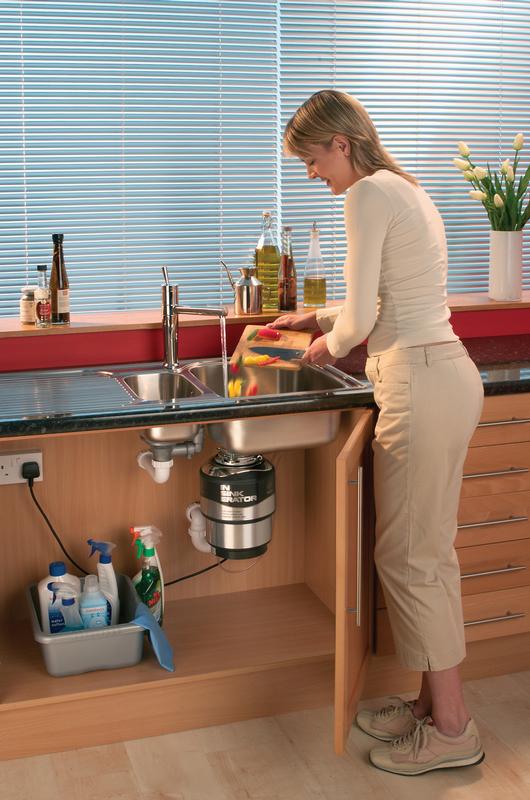
Worcestershire county council, which is one of the only councils to promote food waste disposers in the UK, claims that more councils should help householders to get rid of food waste down the sink to save money and reduce greenhouse gases.
The report found that in-sink disposers were not only convenient and hygienic, but “costs less” and had a “better carbon footprint” than other food waste treatment routes including composting.
Speaking to letsrecycle.com yesterday, Worcestershire county council's project development officer Jeremy Howell-Thomas said: “The value of food waste disposers has been largely overlooked. We would like to see more councils taking advantage of food waste disposers especially as there is more emphasis on food waste in the new English waste strategy.”
“Food waste disposers remove the need for new anaerobic digestion plants and the cost of ongoing food waste collections and could help if people are worried about alternate weekly collections of residual waste,” he added.
Benefit
According to the Environmental Impact Study of Food Waste Disposers, which looks at a “Sink Your Waste” scheme in both Worcestershire and Herefordshire, disposers have the “benefit” of collecting meat-inclusive food waste using existing infrastructure without “entailing any regulatory bureaucracy.”
This method could also save money on collection costs and provides an alternative for people who are not able to compost, it suggests.
If sewage is then treated through anaerobic digestion to produce biogas, as happens in Worcestershire, the study adds that food waste digesters could save over eleven times more carbon dioxide equivalent emissions than composting and cost water companies only 4% of how much it would cost councils to send it to landfill.
The synopsis said: “The carbon footprint of FWD feeding into a waste water treatment works with anaerobic digestion and electricity generation is competitive with separate collection of kitchen food waste delivered to centralised anaerobic digestion with combined heat and power and is significantly better than centralised composting.”
Savings
In Worcestershire and Herefordshire the councils offer up to £80 cashback towards the cost of new food waste disposers and researchers found this could also be recovered through disposal savings in just 3 years and 4 months.
However, both Worcestershire county council and the CSS report admitted there were some barriers to introducing the digesters such as concern amongst water companies about blockages and a lack of awareness amongst the public about the benefits of the technology.
Mr Howell-Thomas said: “1,000 people have signed up for the cashback scheme in Worcestershire and Herefordshire which is relatively small but the rate is increasing all the time as more people become aware of the benefits.”
In the CSS report synopsis, researchers added that water companies had concerns over blockages but claimed there was little basis for them.
It said: “Water companies are understandably concerned about changes that might adversely affect demands on water resources or that would increase sewer blockages but field trials in several countries have shown that food waste disposers do not affect water usage or accumulation in sewers significantly. Wastewater treatment works are designed to treat biodegradable material suspended in water, ie, similar to the output of a food waste disposer.”
Last year, a manufacturer of food waste disposers claimed that the UK was “prejudiced” against food waste disposers because only 5% of the population used them compared to around 50% in the USA (see letsrecycle.com story) .

Register for free to comment