

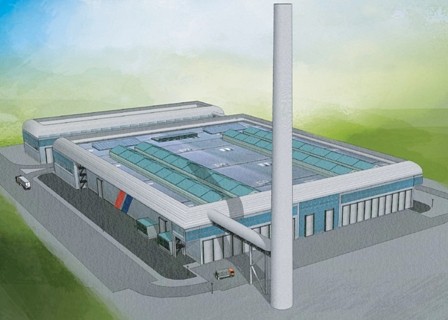
Mexico-based Cemex is proposing to build an MBT facility in Rugby which will be capable of turning 300,000 tonnes of residual household and commercial waste a year into fuel for use in its local cement kilns.

Cemex is looking to enter into an agreement with a specialist waste management company to run the plant, providing an opportunity for firms with MBT experience.
The move follows increasing demand for refuse derived fuel from the UK cement industry and will create what Cemex claims will be a provide “a local solution to the local waste problem”.
At present, the company has to source solid recovered fuel for use in its works in Rugby, Barrington in Cambridgeshire and South Ferriby in Lincolnshire from a range of other MBT plants, including Shanks' Frog Island facility in London.
However, with the majority of the UK's MBT facilities located in the South, and many of the largest cement works based in the Midlands and North, Cemex is hoping to avoid the financial and environmental implications of transporting SRF over large distances – and last year urged councils to develop more facilities (see letsrecycle.com story).
A Cemex spokeswoman told letsrecycle.com: “Having the Climafuel plant nearby would ensure that we minimise traffic and mileage, and so fuel and vehicle emissions, as well as optimising economic activity.”
Cemex had stated that the plant would also be “ideally placed” to process waste from Warwickshire and nearby parts of both Oxfordshire and Northamptonshire.
However, the spokeswoman added that no contracts were currently in place for the waste needed for the plant, adding that “we are exploring a number of options”.
Application
Cemex has already submitted a planning application to Warwickshire county council for one of the two potential plant locations – a disused cement works at Southam – and it plans a similar submission for a site adjacent to its existing cement works, in Malpass, later this month.
It explained that two separate sites had been suggested because “while only one plant would be built, these alternatives, which are equally suitable, will give the council and its citizens the opportunity to decide on the option which best matches local needs and complements the county's future waste strategy”.
The development will include a separation facility, for the recovery of recyclables such as metals, glass, grit and some plastics, paper and cardboard, with the latter three materials later blended into the residual waste to produce Climafuel.
The decision to blend plastics, paper and cardboard could potentially lead to questions over why those materials are not being recycled and are instead burnt as part of Climafuel.
Cemex's UK sustainability director, Andrew Spencer, said: “Reuse and recycling will always by the first choice, but MBT is a complimentary option. It provides a more sustainable solution to the significant and increasing challenge of reducing UK landfill for non-recyclable material.”
Trials
Cemex was given permission in October 2007 to use Climafuel on a trial basis to replace up to 30% of the coal it previously burnt in the kilns at its Rugby works (see letsrecycle.com story).
In 2007, the multinational company ran successful trials of Climafuel at South Ferriby and Barrington, substituting fossil fuel use at a rate of 30% and 20% respectively, diverting 12,500 tonnes of waste from landfill.
The spokeswoman explained that: “On the back of the powerful results of these trials, Cemex has been given permission to use Climafuel permanently in South Ferriby and Barrington.
“The company has also been granted permission to undertake a trial to use Climafuel at 60% substitution rate in South Ferriby, and awaits a similar permission for Barrington later this year.”
And, with regards the trials of Climafuel at the Rugby works, she indicated that they were underway and were set to be completed by the autumn.
She explained: “Early indications suggest that using Climafuel has considerable environmental benefits. On that basis, we hope at the end of the trial to demonstrate that all the other key performance indicators have been met and secure the permit in Rugby to use Climafuel permanently.
“As at our other plants, once this process has been completed, we would also look at opportunities for increasing the substitution rate,” she added.
Tyre
Cemex's decision to increase the use of SRF comes alongside an increased use of chipped tyre as a fuel for its kilns, which saw it being given permission in November 2007 to raise the percentage of fossil fuel it replaces with chipped tyres at Rugby from 12% to 25% (see letsrecycle.com story).
However, the spokeswoman indicated that “we do not have any plans for going to 100% alternative fuels” at the Rugby works, as well as revealing that the company has not plans to build MBT plants near to its three other cement works in the UK.
If planning permission is given, Cemex hopes to have the plant up-and-running by 2010.

Register for free to comment