



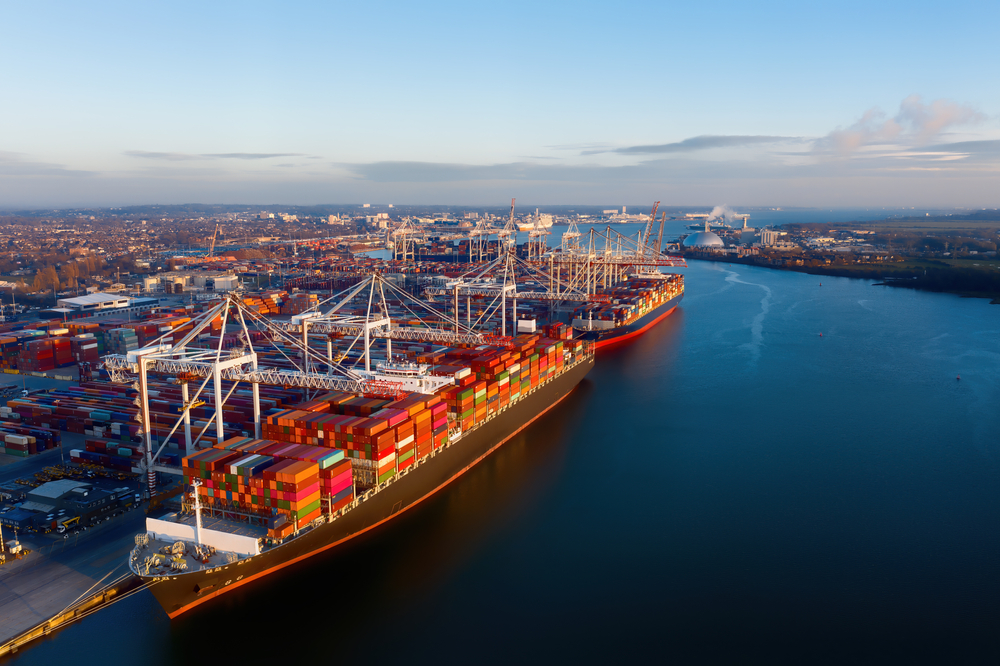
Many UK reuse merchants send their textiles to secondary markets in the Middle East, but demand has plummeted due to the conflict.
On Saturday 28 April, the US and Israel launched a major airstrike against Iran which has triggered conflict across the region with significant disruption to trade routes and port activity.
Several industry sources have said they have had to pay for their goods to be transported inland, away from vulnerable ports in the Middle East, or paid for return shipping to the UK.
This is alongside the rising fuel and shipping costs being faced across the world.
Major shipping lines such as Maersk and MSC have implemented “war surcharges” ranging between $100 to $400 per container.
For a sector already on the brink of collapse, this might be the final blow. Local authorities are being warned to expect significant cost burdens, which will likely be accelerated once the Emissions Trading Scheme (ETS) goes live in 2028.
Peter Page, Chairman of the Textiles Recycling Association (TRA) and Group Director at Textiles Recycling International (TRI), said: “The UK textiles sector is on the brink of collapse.
“Crushed by relentless cost increases and abandoned by a government that has failed to deliver meaningful support, businesses across the value chain are being forced to shut their doors.
“Collectors are disappearing at an alarming rate, while the explosion of ultra-fast fashion and the sharp decline in reusable textile quality are accelerating the sector’s deterioration on a global scale.”
A sector on its knees
The second-hand textiles sector is being overwhelmed by the amount of “ultra-fast fashion” being produced by brands like Shein and New Look.
Traditionally in the UK, textiles which charity shops cannot sell are collected by “collector, sorter and processor” merchants. The merchants are charged a fee to “buy” the stock from the charity shops.
The same is true for textiles dropped off at textiles banks, for example at recycling centres or outside supermarkets.
The clothes are then usually graded by quality to be sent for reuse in secondary markets in Africa and Asia.
Items which cannot be sold overseas are discarded as waste via landfill or incineration.
However, the low value of ultra-fast fashion items has undermined this system, with overseas exporters no longer interested in low-grade textiles coming from the UK.
At the same time, end markets such as those in Eastern Europe and the Middle East have been disrupted due to ongoing geopolitical tensions.
Page added: “Escalating conflict in the Middle East is actively destabilising global supply chains.
“Key shipping routes are under sustained pressure, forcing diversions, delays, and spiralling costs.
“Freight operators are imposing war risk and fuel surcharges at unprecedented levels, compounding an already unsustainable economic environment.
“These disruptions are not temporary shocks, they are systemic threats to the movement of goods worldwide.”
A warning to local authorities and charity shops
Local authorities are already facing the effects of the crisis, with many reuse merchants now implementing gate fees to collect from Household Waste Recycling Centres (HWRCs).
These fees currently sit between £100 gate fee and £0 for collection.
However, this number continues to rise, and it is currently unclear where it will settle.
Local authorities have also warned that the ETS will incur extra costs for the incineration of textiles, due to the high percentage of textiles that are made of plastic.
The warning has been extended to charity shops which sell an average of two thirds of clothing donations to merchants, according to the Charity Retail Association (CRA).
Merchants currently pay for these costs, but it is likely that this number may drop to a gate fee in the future.
What about textiles recycling?
Recycling technology and capacity in the UK and globally is nowhere near where it needs to be to meet demand and process the kind of material being sorted.
For the most part, “textiles recycling” is a myth and does not happen at scale. What is often referred to as “recycling” is actually either reuse in mostly foreign markets or incineration. Merchants are an essential part of this process.
A number of collector, sorter and processor merchants have called for the charity sector and waste management companies to “hold tight” and continue supporting them while the industry and government catches up in innovation and funding.
Circular Economy Growth Plan not a ‘silver bullet’
The industry has been awaiting the Circular Economy Growth Plan which is rumoured to include plans for an Extended Producer Responsibility scheme for textiles (tEPR).
The growth plan is now expected in “Spring 2026”, having been delayed from late 2025.
However, experts have warned that the growth plan should not be viewed as a “silver bullet”.
The Extended Producer Responsibility for packaging (pEPR) was first announced in 2018 and took approximately seven years to go live.
EPR is a method of charging waste producers (in this case, fashion companies) for the cost of the waste management of their products.
Page concluded: “Without urgent intervention, the UK textiles industry faces a full-scale standstill.
“The government’s continued failure to deliver a coherent circular economy roadmap is not just an oversight, it is a critical policy failure that is choking the sector at a time when resilience and sustainability should be national priorities.
“If this trajectory continues, the collapse of the UK textiles ecosystem will not be gradual, it will be abrupt, and it will reverberate across global supply chains.”

Subscribe for free