
The report, titled ‘REview22’, was published last week (10 November) and examined the state of the industry. It looked at the renewable energy and clean technology sector, mapping the energy transition on the path to net zero.
The report highlighted that the UK met 13.6% of its total energy consumption from renewables at the end of 2020, falling short of the target of 15%.
On the other hand, it also showed the largest increase in AD power generation since 2017. It explained that 2017 has seen approximately 2,250 GWh produced, with the number rising to more than 3,250 GWh produced in 2021.
Market
It explained that grid capacity constraints continue to be the largest barrier to the delivery of more renewable energy generation.
The report outlined that while the government is consulting on further market reforms for mass renewables rollout, “there remains no route to market for long duration energy storage”. It argued that the progress has been slow.
The document also emphasised the importance of renewables in the context of the global gas demand and the Russian attack on Ukraine. It added that “the rapid deployment of renewable and clean technologies, accompanied by meaningful market reform, is both the answer to decarbonisation and a solution to the delivery of an affordable secure power system”.
Anaerobic digestion
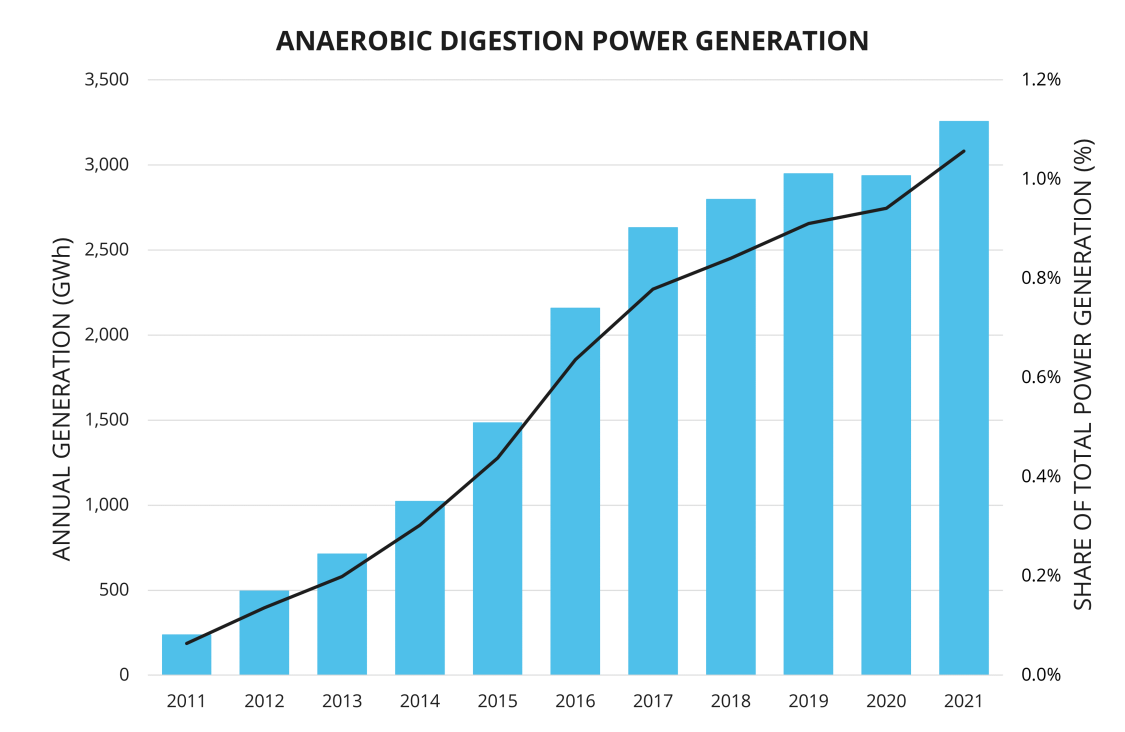
The report emphasised the growing importance of AD in renewable energy generation.
It continued that the near 11% rise in 2021 in AD power generation since 2020, which “saw a small dip”, has been the largest increase since 2017. The report added this accounted for over 1% of the share of total power generation.
The report suggested that AD is set to continue its growth trajectory “with steady growth rates rather than a spectacular explosion”.
Jenny Grant, REA’s head of organics and natural capital, commented: “With many details still to be confirmed, the industry is eagerly awaiting the government’s response to the consultation and further details on timings on separate collection of food waste. We should see an increase in the amount of unavoidable food waste and garden waste available to be treated through composting or anaerobic digestion.”
Even despite the missed target, the report pointed out that bioenergy sources account for more than half of the UK’s total renewable heat generation.
The document noted that wind energy remains the dominant technology within the sector, with offshore and onshore accounting for more than half of all renewable generation. It added that solar photovoltaic system produces around 10%.
‘Opportunities’
Dr Nina Skorupska CBE, CEO of REA, said: “We are projecting that thousands of new jobs and billions of pounds will be added by the sector by 2035, and these figures could be even greater should the Government deliver the right support. Of course, these numbers are by no means guaranteed if the Government continues to provide patchy and unreliable policy.
“We are clear, tackling climate change and boosting our economy is not an ‘either-or’ decision. In fact, it goes hand in hand. I would urge the Government to recognise the opportunities on offer for our country and finally match their warm words with action.”

Register for free to comment