

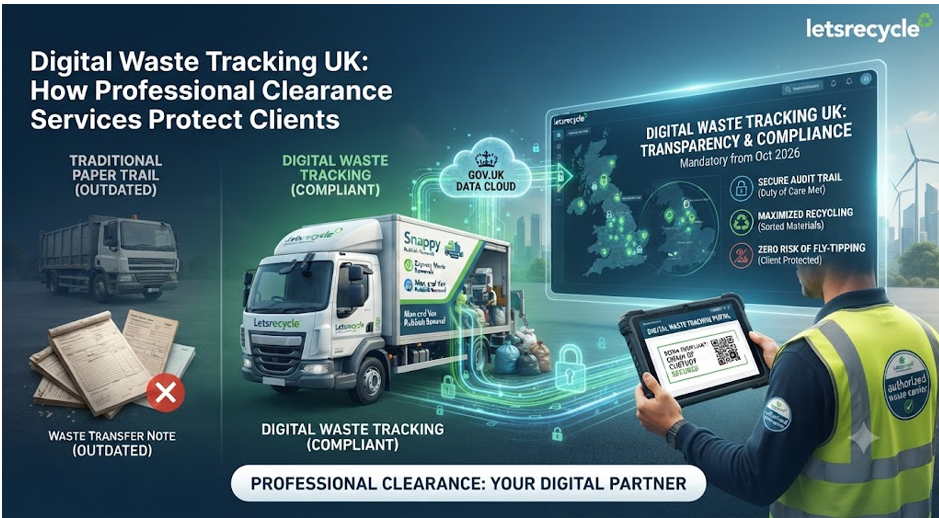
For businesses, landlords, and homeowners, these paper trails were easy to misplace and even easier for rogue operators to exploit.
However, a massive digital transformation is underway. With Defra’s Digital Waste Tracking Service (DWTS) launching its public rollout and heading toward mandatory enforcement from October 2026, the way waste movements are recorded is changing permanently.
For all Londoners—ranging from private homeowners clearing a property to corporate tenants managing large-scale office relocations—this shift marks the end of opaque disposal methods and the dawn of absolute transparency.
Knowing about the impact and how to comply is key in navigating successfully through the upcoming changes.
Understanding the Legislative Shift: What is Digital Waste Tracking?
Driven by the Environment Act 2021, the UK government is phasing out paper-based records to tackle waste crime, which costs the UK economy an estimated £1 billion annually.
The new digital tracking system creates a unified, near-real-time electronic record of every movement of controlled waste.
- Phase 1 (October 2026): Officially becomes mandatory for all permitted and licensed waste-receiving sites (such as transfer stations, recycling facilities, and authorized treatment yards) in England, Wales, and Northern Ireland (with Scotland following in January 2027).
- Phase 2 (October 2027): Will formally extend mandatory direct digital entry requirements down to waste carriers, brokers, and dealers.
Under this framework, every load deposited at a permitted site must log precise data, including European Waste Catalogue (EWC) codes, digital signatures, timestamps, and exact processing outcomes.
The Risks for Businesses and Private Entities in London
Many private and commercial entities assume that once waste leaves their premises, their legal “Duty of Care” is completely fulfilled. Under modern regulatory enforcement, that is a dangerous misconception.
If a business or homeowner hires an unlicensed, cheap clearance operator who subsequently fly-tips the rubbish, the original producer of the waste can—and will—be held legally liable. Fines for breaching duty of care can reach up to £50,000, alongside severe reputational damage as Snappy Rubbish Removals founder Stoyan Stoykoff explains in his interview with London Business News Magazine. He highlights: “Fly-tipping is a huge problem for big cities like London as statistics show: For the 2020/21-year, local authorities in England reportedly dealt with 1.13 million fly-tipping incidents, an increase of 16% from the 980,000 reported in 2019/20. So, there is an ongoing increase in waste crime.”
In the digital era, gaps in an audit trail are instantly noticeable. Regulators can cross-reference data rapidly, meaning rogue operators and the clients who use them have nowhere to hide.
How Professional London Waste Removal Services Simplify Compliance
Partnering with established, fully licensed rubbish removal specialists shields both private and business clients from these evolving regulatory headaches.
Professional operators bridge the gap between everyday consumers and strict environmental laws in several ways:
1. Instant Audit-Ready Transparency
Professional clearance companies that utilize structured digital workflows ensure that every item cleared—whether it is old office furniture, retail fit-out debris, or household junk—is documented correctly. When waste arrives at a licensed sorting or recycling facility, it enters the digital chain of custody immediately. Clients receive clear confirmation of legal disposal, removing any ambiguity.
2. Specialized Sorting and Landfill Diversion
The modern regulatory environment heavily penalizes mixed, unsegregated waste. Professional removal services don’t just dump trash; they actively separate materials (wood, metals, plastics, and electrical components) at specialized transfer yards. This ensures maximum recycling rates and keeps businesses aligned with corporate sustainability goals.
3. Seamless Logistics for Urban and Commercial Spaces
For businesses moving offices or homeowners clearing restricted urban properties, navigating local parking laws, ULEZ restrictions, and waste transfer paperwork can be overwhelming. Trusted specialist clearance providers offering tailored services like “move in and out services” by Express Waste Removals or “same day waste removal services” by Man and Van Rubbish Removal manage the heavy lifting, legal transport, and documentation end-to-end.
Best Practices: What Londoners Should Do Now
As the October 2026 enforcement milestone approaches, private clients and business operators should take proactive steps to future-proof their clearance processes:
- Audit Your Clearance Partners: Always ask your waste carrier or clearance provider for their Environment Agency registration number and confirm how they handle digital tracking and waste transfer documentation.
- Ditch Informal Handshakes: Avoid unverified online operators offering suspiciously low cash-in-hand rates for rubbish removal. If they cannot provide a verifiable digital paper trail, your business is exposed to legal risk.
- Integrate Waste Audits Early: For commercial offices and landlords, build waste management plans into your operational calendar early. Knowing your waste codes and volumes makes transitioning to digital reporting seamless.
Let Professionals Manage Your Waste Disposal for Peace of Mind
Digital waste tracking is raising the bar for the entire UK property and waste management sector. While the transition introduces tighter oversight, it ultimately levels the playing field for legitimate, responsible businesses. By teaming up with professional, transparent waste removal services, private homeowners and corporate clients alike can completely eliminate compliance risks, protect the environment, and step confidently into a fully digitized future.
