

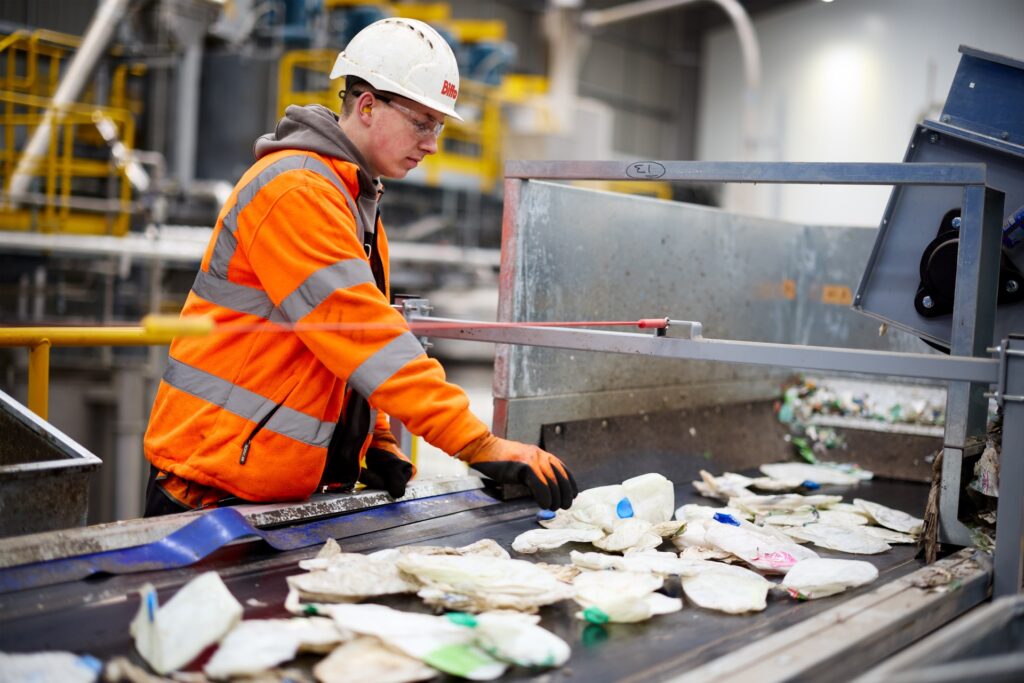
The launch of the report from Hybrid Economics came as Biffa reached 10 billion HDPE milk bottles recycled, since it first began processing them 20 years ago.
It warned that current plastic policy misses economic opportunities, particularly as the sector faces increasing difficulties such as plant closures and unfavourable market conditions.
10 billion bottles processed
Biffa’s 10-billion-bottle milestone is framed as a proof point: when conditions are right, large-scale UK plastics recycling is viable.
James McLeary, Managing Director of Biffa Polymers, commented: “Reaching 10 billion recycled HDPE bottles shows what long-term commitment and innovation can deliver.
“Two decades ago, we were the first to prove these bottles could be recycled at scale in the UK. Today they are one of the country’s clearest circular economy success stories.”
The accompanying report suggested that this same model – long-term investment supported by consistent policy – could be applied to the UK’s entire plastics recycling system.
UK exports half its recyclable plastic waste
Despite steady growth in domestic recycling capacity, only half of UK plastic packaging waste is currently recycled, and just half of that is processed in the UK.
Biffa cautioned that exporting unprocessed plastic waste allows the UK to sidestep responsibility for managing its own material flows, with the report warning that this practice is rapidly becoming untenable as:
- More countries are refusing to import unprocessed waste, raising the risk the UK will be forced to retain material it cannot yet recycle.
- At the same time, exporting waste denies the UK major economic gains, from private investment and job creation to supply-chain resilience.
Neville Hill, Partner at Hybrid Economics, noted: “The UK has built a strong plastic recycling sector over the past 15 years, but it is only using half of its potential.
“Ending exports of unprocessed plastic packaging waste by 2030 would allow the UK to take control of its environmental responsibilities and seize a clear economic opportunity.”
All plastic processed onshore by 2030
The report outlines a scenario in which, by 2030, the UK stops exporting unprocessed plastic packaging waste entirely and processes all of it domestically.
Achieving this would require over £800 million of private-sector investment in world-class recycling infrastructure.
This would equate to around 15 new facilities, capable of processing an additional 900,000 tonnes of plastic waste annually.
The potential economic benefits are substantial, with the report estimating nearly £900 million in economic output each year. This would include at least £100 million in new tax revenues for the Treasury.
The report also explained that this investment would lead to 5,400 new direct and supply-chain jobs, rising to over 9,000 when combined with existing sector capacity.
A policy package for plastics
The report emphasised that industry can deliver this expansion without government spending, but only if the policy environment supports investment. It proposed several measures:
- A Plastic Packaging Tax escalator to 50%, driving demand for recycled content
- Third-party certification for imported recycled plastic, ensuring quality and fair competition
- Certification for food-contact recycled materials, opening up high-value markets
- A phased ban on exports of unprocessed plastic waste, creating predictable demand for UK capacity
McLeary added: “The lesson is simple. When the right conditions are in place, UK recycling grows, investment follows and the environmental and economic benefits build year after year.
“The research we are publishing today sets out how the UK can replicate that success across all plastic packaging and take responsibility for processing its own waste onshore.”

Register for free to comment