
The £14 million plant at Stormy Down is thought to be the largest food waste processing site in Wales and will take in waste from Ceredigion, Powys and Pembrokeshire councils – which had previously been sent to Agrivert’s AD plant in Cassington, Oxfordshire.
Agrivert entered into a 15-year contract with the local authorities for the treatment of food waste – worth close to £11 million – in 2012 (see letsrecycle.com story).
According to Agrivert, the facility – its fourth AD plant in the UK – was built and opened in record time, with construction work having begun in February 2016 and completed in September. As of last week – the site is running at close to 95% capacity.
The facility is housed at Parc Stormy, an out-of-town brownfield site and former World War II airfield which is now home to a number of renewable energy projects including solar and wind energy generation as well as a cement kiln which uses waste derived fuels for energy production. There are also plans to add a second wind turbine, a 10MW Battery Storage project as well as a Hydrogen Refuelling Station.
Process
Food waste arriving at the plant is de-packaged to remove contaminants such as plastic and liquidised to produce a thick organic ‘soup’. This is then pumped into one of five 600 cubic metre capacity concrete digesters where bacteria breaks down the organic material – as part of a process lasting 85 days.
Methane gas is collected, cleaned and fed into a gas engine, which powers a generator to produce electricity that is exported to the National Grid.
The plant also generates renewable heat, some of which is used to heat the pasteurisers and digesters on-site. Agrivert is also exploring plans to provide surplus heat to neighbouring businesses.
Digestate produced at the plant is pasteurised before being used as a fertiliser on arable land – much of which will be pumped directly from the AD plant onto a neighbouring farm – reducing vehicle movements to and from the site.
Carbon savings achieved at the plant would be equivalent to taking 130,000 cars off the road – Agrivert claims.
Minister
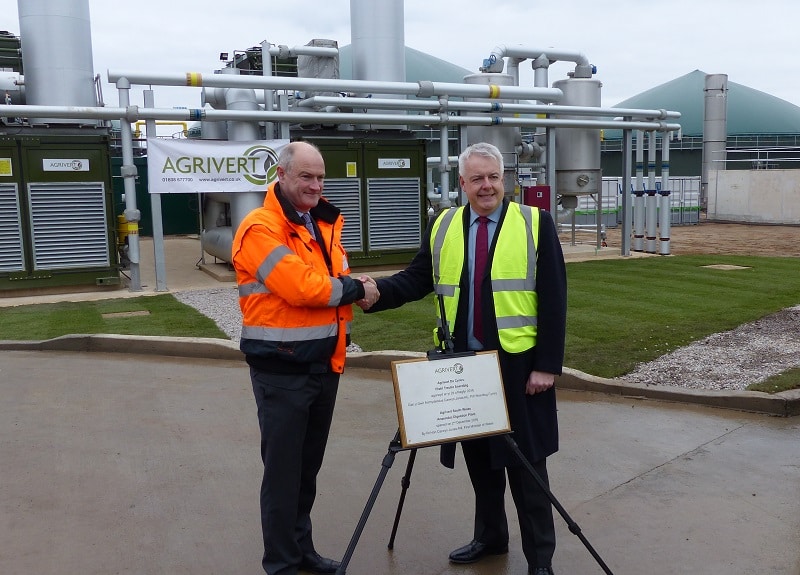
Cutting the ribbon alongside Agrivert’s chief executive Alexander Maddan, Mr Jones said: “It is great to see this plant opening in my own constituency.”
The Welsh First Minister added that anaerobic digestion has an important role to play in the handling of Wales’ waste. He said: “I’m pleased to say we are now recycling 60% of our waste which is a tremendous change from where we were 15 or 16 years ago.
“It is because of the development of the market and the technology that we see today that that has been possible.
“For many years in Wales now we’ve been recycling food waste and for many years that mainly ended up as compost but we know there’s a limit to the amount of compost that the market can take.
“I’m pleased to say we are now recycling 60% of our waste which is a tremendous change from where we were 15 or 16 years ago.”
Carwyn Jones
Welsh First Minister

“So there is a need to ensure that new ways are developed to reuse food waste and we are seeing that here today – waste being turned into energy – or waste into wattage as I think the phrase is used on this site.”
Agrivert
Speaking at the opening ceremony with around 50-invited guests, Mr Maddan, said: “We are proud of this AD project and the increased accessibility to our industry-leading food waste recycling services it brings.
“The new plant will offer much needed reliable capacity to local markets and we are pleased that large volumes of waste are already coming in from local sources. Local plants such as this reduce the cost of waste collection and treatment and should provide an incentive for many businesses to recycle food waste.
“We are delighted to be working with Ceredigion, Powys and Pembrokeshire Councils, who have been supportive partners at every step. Indeed we could not have delivered this facility so quickly if we had not had such a progressive relationship.”
Agrivert is currently building an AD facility for Severn Trent, which will be delivered in February of 2017. The company serves around 36 local authorities and operates nationally – handling both food and green waste.

Register for free to comment