

The review, published last week, looked at the ways waste efficiencies can be delivered despite continuing budget restraints within the region.

The North West region has a population of 7 million, and densities varying from 2,100 people per sq. km in Merseyside to 70 people per sq. km in Cumbria and is the third largest in the UK. A total of 22 out of 43 authorities took part in the research.
Local Partnerships found that there have been “great strides” in delivering budget efficiencies and, despite a reduction in resources, “service expectations remain high”.
In terms of the £20 million savings, most appear to be achievable on an annual basis while some are one-off savings, and, Local Partnerships note that this figure is a “conservative estimate”.
Benefits
The “overwhelming driver for the authorities in the review is economics”, according to the report, rather than for other benefits such as improving recycling rates.
And the report highlights how achieving higher recycling rates is no longer a priority. For the councils in the North West, it points out that “action will not necessarily be taken simply to generate an increase in percentage points for recycling; the main priority is generating value for money services within a limited public budget.”
The report is the fifth regional review on waste efficiencies by Local Partnerships, a body jointly operated by HM Treasury and the Local Government Association. To read the full report, click here.
Findings
Findings confirm that the North West region rates third in England for recycling performance with a rate of 46.5%. Landfill remains high at 31.8% but kg/household residual waste is low compared with other regions.
 According to Defra’s latest figures for 2014/15 – Trafford and Wyre are achieving recycling rates of 61.90% and 51.10% respectively and top the North West recycling rates. Burnley achieved the lowest recycling rate of 31.70% and was one of eleven authorities in the report which failed to reach a rate of 40%.
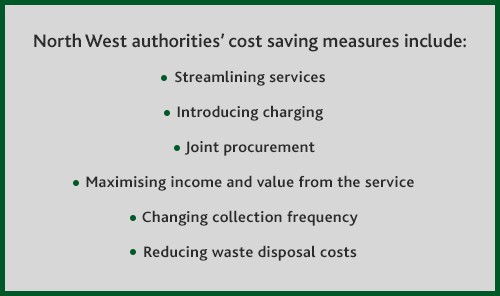
Local Partnerships found that authorities in the North West have delivered savings on waste budgets by focusing on areas such as route optimisation, streamlining services, joint procurement, changing collection of frequency and maximising incomes from services.
Introducing separate food waste collection kerbside was felt by many authorities questioned for the report as the only option in increasing recycling percentages but is a system that only St. Helens and Sefton currently offer.
The report cites many examples of action by individual authorities.
Frequency
For example, reducing collection frequency while maintaining overall capacity in Bury and Rochdale, enabled significant increases in recycling throughout 2015.

Tameside introduced the Bin Swap scheme in 2015 switching from the residual black 180 litre bin to the recycling green 140 litre bin providing more recycling capacity and diverting a further 25% of landfill waste away from landfill (see letsrecycle.com story). Through the scheme and other initiatives, Tameside have made the biggest savings in the North West region with a reduction in operating costs of £1.9M and reduction in the levy of £3M per annum.
Elsewhere, Greater Manchester WDA and Merseyside RWA are in a “mutual agreement” enabling GMWDA to capitalise on the spare treatment capacity at its thermal and MBT facilities. MWDA is just one authority to make use of this spare capacity. Over the last three years, around 200,000 tonnes of waste has been processed through the facilities enabling GMWDA to meet its austerity targets through the income generated.
All authorities provide an alternate week collection service including residual, dry recyclate and garden waste collection with two authorities adopting a 3 weekly residual and dry recyclate collection and one providing a weekly residual collection.
In-sourcing
Similarly to the North East (see letsrecycle.com story) and Yorkshire and the Humber region, ‘in-house’ collection dominations with just five of the authorities outsourcing collection arrangements. Sefton were highlighted in the report for achieving a saving of approximately £1 million by insourcing all aspects of their service.
Looking ahead, Hyndburn offers thoughts on future efficiencies. The authority remarked how reducing budgets does not make efficiencies and that the time will come when the process is unable to be streamlined further meaning budget reductions will only be possible by changing service provision – seen as a strong political point in local government.
The final section of the report contains case-studies, or ‘completed profiles’ for all the authorities covered in the study.
Local Partnerships: Delivering Waste Efficiencies in the North West – Report


Register for free to comment