

The quarterly ‘waste from households’ data, which covers all of the waste handled by local authorities, shows that England achieved a quarterly recycling rate of 48.5% for the first quarter of 2014/15, higher than its previous best of 47.6%, recorded in July to September 2012.

The recycling rate is also significantly higher than that for the first quarter of 2013/14, when a combined recycling and composting rate of 47% was recorded.
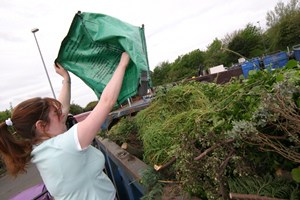
Defra attributes some of the increase to a rise in composting of green waste, which could be thanks to a warmer than average spring felt across England in 2014. According to the Met Office, temperatures were around 3.0 °C warmer in spring 2014 than in 2013.
1.5 million tonnes of green waste was collected and treated on behalf of councils in the first quarter of 2014/15, compared to 1.29 million 12 months earlier.
[testimonial id = “180” align=”right”]
When added to the previous three quarters, England’s 12 month rolling recycling rate now stands at 44.9%, an increase of close to 1% across that period.
Target
While this improvement will come as welcome news to local authorities and the waste sector, it is unlikely to allay fears that councils in England could miss the EU’s mandatory 50% by 2020 recycling target.
Defra itself has acknowledged that the target could be difficult to meet on the current trajectory, and in November it enlisted the Waste and Resources Action Programme (WRAP) to investigate what can be done to increase recycling rates across England (see letsrecycle.com story).
Commenting on the figures today, resource management minister Dan Rogerson said: “As these latest figures show, the amount of waste going to landfill continues to fall, reflecting a lot of hard work by local authorities and a desire from householders to recycle more.
“We remain committed to building on this success and recycling 50% of our household waste by 2020. We continue to support local authorities’ efforts to promote recycling and are also working with WRAP to see what further measures may be needed to achieve this.”
 Detail
Looking in detail, the figures show that a total of 3.3 million tonnes of waste was sent for recycling or composting during the quarter, while the amount of waste sent to landfill continued to fall. This was coupled by an increase in the amount of local authority waste sent for incineration.
In total 1.58 million tonnes of waste was sent for landfill in April to June 2014 – compared to 1.89 million tonnes in the corresponding period one year earlier, while the amount sent for incineration stood at 905,000 tonnes, compared to 654,000 tonnes 12 months earlier.
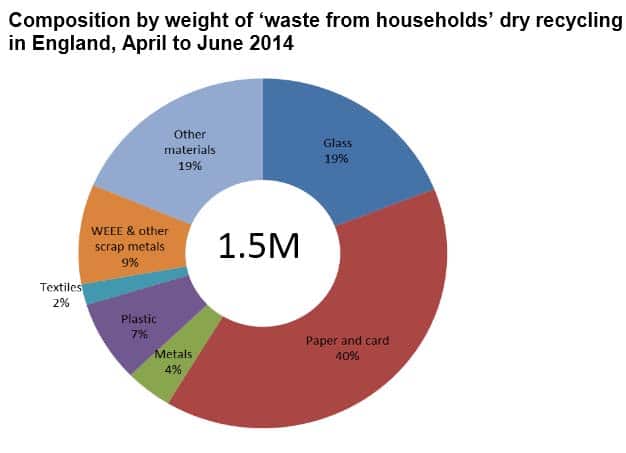
The composition of dry recycling has remained broadly consistent with levels experienced since 2010 with the bulk of the material comprising paper and card (40%), followed by glass (19%) and plastic (7%).

Register for free to comment