

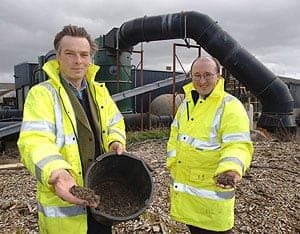
Following the completion of the company's second in-vessel composting plant, Bioganix is aiming to raise finance to help expand its business.
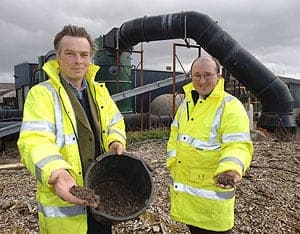 Bioganix managing director Nick Helme (left) with Julian Morgan, managing director of Bioganix parent company 7Y |
Set up in 2001 by farmer Nick Helme, Bioganix built its first in-vessel composting plant at Wharton Court, Leominster, which was given clearance to operate under animal by-product legislation in July 2003.
The Leominster plant processes about 12,000 tonnes of material each year into compost, and has been profitable for the two years up to December 31, 2005, the company said.
Contract
Using a modular design, the company's horizontal in-vessel technology has now been used in a second plant in Ipswich, which becomes operational this month.
Under a new 10-year contract with Suffolk county council, Bioganix will treat about 12,000 tonnes of green and kitchen waste every year in the Ipswich plant. There will also be capacity spare for the treatment of waste outside the Suffolk contract, with planning permission allowing 35,000 tonnes of material to be processed each year.
Bioganix managing director Mr Helme said: “The Bioganix process is designed to fit into a factory environment and to meet the most stringent legislative requirements. This is giving us the ability to locate plants where they are needed and allows access to a very wide range of waste feed stocks.
“These include local authority wastes, food industry wastes and “out of code” supermarket products, all paying a gate fee to take their material,” Mr Helme explained.
Funding
Defra has given Bioganix funding through the New Technologies programme to carry out further research and development work on its process at the Leominster plant.
| Related links: |
In a statement to potential investors, Bioganix stated that its turnover had grown from 297,000 to 698,000 in 2005. An operating loss of 520,000 in 2003 had been turned into a “small profit” by 2005, it added.
“Our AIM listing will give us access to the capital required to build on our existing business by adding further plants,” Mr Helme said.

Subscribe for free