
Rick Hindley, executive director of Alupro, the organisation which works to promote aluminium recycling, says that the aim is all about getting local authorities to do more and getting the message over to the consumer.
The organisation will continue to be promoting the recycling of aluminium cans but is also aware that foil recycling rates need to rise. However, there is no foil recycling rate as such as the vast majority is collected and reprocessed mixed with cans so it is not possible to identify or indeed estimate volumes. The official rate for all aluminium packaging (including foil) is 45%.
(Video is one of several by Alupro to enhance the foil recycling message to the public)
In terms of the aluminium recycling challenge, a range of materials are targeted with the main focus being cans as this represents the largest volume. Some 160,000 tonnes of aluminium packaging are sold each year and the vast majority is drinks packaging in the form of cans, equating to about 100,000 tonnes.
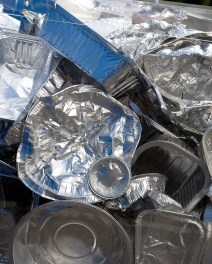
Also placed on the market are 16,000 tonnes of foil containers and 6,500 tonnes of plain foil, such as used to wrap chocolate and for use as a top material for yogurts. The balance is mainly made up by 38,000 tonnes of aerosols and pet food containers.
Seasonal foil products such as Christmas turkey roasting trays remain an area which are still not specifically targeted by Alupro as they are not classified as packaging under the Packaging and Packaging Waste Directive. So, some producers and especially importers of foil trays appear to be escaping from any duty to recycle or to contribute towards the recycling message.
In terms of foil, Mr Hindley explains that the industry started promoting recycling of aluminium foil back in the 1980s with community groups collecting it via banks.
These groups would sort it and then sell it on. We still have a hardcore of groups still active but we needed to increase volumes so we have expanded collection to the kerbside schemes run by local authorities.
And he is adamant that collecting the material for recycling is not a problem: It can be collected with beverage cans and recycled at plants such as Aleris in Swansea and Novelis in Warrington.
The plants can handle foil as long as it is collected at relatively low levels with cans which is usually the case when the material is collected at the kerbside.
Separately collected foil, and foil separated out at some materials recycling facilities, can go to specialist smelters such as Avon Metals in Gloucestershire and Norton aluminium in Cannock. Some material is also exported.
Alloys
Technically, explains Mr Hindley, aluminium foil cannot be recycled back into aluminium foil because of the alloys involved. Instead, typically it is recycled into other aluminium products such as for the motor industry.
He emphasises that the focus now is very much on collection and the messages to consumers is that:
- Foil is 100% recyclable
- It can go for making in to a range of aluminium products
- Collection can be separately and mixed in with other aluminium packaging
- Important to ensure that it is foil and not metallicised packaging.
- Aluminium foil needs a quick rinse to remove food waste.
At an incinerator it would be recovered from the bottom ash for reuse. The aluminium industry is still seeking to have this material counted as recycled and is in discussions with the Department for Environment, Food and Rural Affairs of this being established within a protocol agreement. If it was to be agreed, this would boost recycling levels and also increase the number of PRNs available under the packaging and packaging waste directive.
Campaigns to date have sought to increase the visibility and number of councils collecting foil as well as understanding the implications for MRFs. The target set by Alupro was to get 80 more local authorities (58% of councils already were) to collect foil.
Mr Hindley explains: We identified contracts coming up for renewal and tried to identify the opportunity for councils to collect at no additional cost. Over a two year period, 28 campaigns were funded around aluminium foil and many others used the website and downloaded material, aerofoil.org.uk.
Recognising that some local authorities werent going to add foil collections to their kerbside work Alupro has supported bank development by some councils with trials for some authorities in Derbyshire and Nottinghamshire.
On-pack labelling success
The development of foil collection has been bolstered by getting foil listed on-pack-labelling as category one status widely recycled which, says Mr Hindley with some prides has only been achieved because of the availability of kerbside recycling and other schemes.
The structural side of the campaign work now sees Metal Matters and Aerofoil run as one campaign with the aim of collecting more material.
One big project is working with 600,000 householders in Kent in a scheme half-funded by local authorities and half by industry.
Mr Hindley says that: A range of programmes are continuing in 2013 confirming foils status as by far the largest industry funded programme to support the collection of material from households. By the end of January 2013, we will have worked with30 local authorities to develop foil recycling and 13 will have added foil.
The first of these this year was the launch of a six-week campaign last month (January) which was the first of its kind to launch in London, and involves two leaflet drops delivered to all 365,000 households across the four Boroughs in the South London Waste Partnership Croydon, Kingston, Merton and Sutton.
This will be supported with outdoor advertising on buses, trams and collection vehicles to remind people that all metal packaging can be recycled and reused endlessly. The campaign will be supported by local activities organised by each of the boroughs.
With support from Viridor, the South London campaign is the first to receive a direct financial contribution from a waste management contractor and is also backed by Recycle for London.
MetalMatters
Mr Hindley said: The South London campaign is a great way to kick-off MetalMatters in 2013. We are delighted to be working with Recycle for London, and that Viridor have agreed to come on board and make a significant financial contribution to the campaign; it makes it a true partnership programme. We are looking forward to seeing the impact the MetalMatters campaign has on metal packaging capture rates.
Related links
This is the first MetalMatters campaign to launch in 2013 and follows five other projects that ran around the UK in 2012.
In all, says Mr Hindley, over 2 million households have now been reached by the programme since Alupro was charged with project management by founding partners BCME, Novelis Recycling and Tata Steel in 2011.


Subscribe for free