

The publication of the revised guidance this week came after WRAP was criticised ahead of the local elections in May 2007 for advising council officers to keep the start of alternate weekly collection schemes away from election periods.

“Despite your best efforts, the introduction of AWC is unlikely to be popular with all residents. Public concerns are often expressed through their elected representatives,” the guidance points out.
Around 180 councils in the UK now operate some form of alternate weekly collection scheme, which involves residual waste being collected from households fortnightly, with recycling collected on the alternate week. More than 90% of authorities in Northern Ireland and over half of councils in Scotland are using such systems.
WRAP states that alternate weekly schemes are “not suitable for all authorities”, suggesting that they will prove easiest to introduce in “medium density housing” areas, “due to ease of access for collection vehicles and sufficient space for the storage of multiple containers at individual properties.”
The guidance, written for WRAP by consultancy Entec, says there are now successful schemes being used in more urban boroughs and cities, but that alternate weekly collections have not been used in the most densely populated areas.
Food waste
Sacks are not generally suitable for AWC of residual waste which includes food.
WRAP guidance
Food waste is identified within the guidance as “one of the most common concerns” residents have about having their non-recyclable waste collected fortnightly.
WRAP states that a fifth of the residual stream, on average, is made up by food waste, and urges councils to offer separate weekly food waste collections if rolling out alternate weekly systems. Uttlesford council found that 45% of its residual stream was food waste, and has decided to run food waste collections.
“For local authorities considering AWC, WRAP's advice is that serious consideration ought to be given to the integration of a weekly food waste collection into the design of any new AWC schemes. It increases the amount of waste collected for recycling, is likely to be acceptable to residents and when delivered alongside fortnightly refuse collections can be a cost-effective means of diverting biodegradable materials from landfill,” it says.
Success
In its guidance, WRAP points out that 19 of the top 20 councils for recycling in England during 2005/06 were using alternate weekly schemes, with the exception, Three Rivers, restricting residual waste collections by using smaller (140-litre) bins on its weekly scheme.
The combined recycling and composting rates of these alternate weekly authorities ranged from 40.3% to 51.5%, it said.

Bins
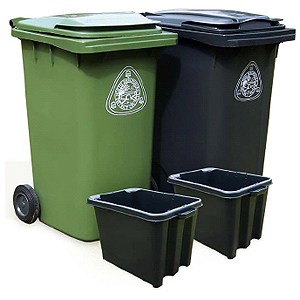
The guidance notes that many authorities use 240-litre bins for residual waste on alternate weekly schemes, and advises councils to maintain the overall collection capacity for residents with the split between residual and recycling capacity depending on the range of materials that can be collected for recycling.
South Somerset, Taunton Deane and Uttlesford councils have supplied 180-litre refuse bins when moving to alternate weekly schemes from weekly sack collection services, since they also introduced weekly food waste collections.
WRAP warns that “sacks are not generally suitable for AWC of residual waste which includes food”.
It says that experience from existing schemes suggest that when residual waste bins are collected, they are likely to be 1.5 times the normal weekly weight – about 17-22 kg each compared to 12-15kg on weekly schemes.
Scrapping schemes
Some councils, like Telford and Wrekin, are reviewing their use of alternate weekly collection schemes in the light of local election pledges by councillors (see letsrecycle.com story). Blackburn with Darwen council has decided to abandon its scheme, first introduced in 2003, phasing in weekly residual waste collections from September.
The Labour-controlled unitary council will return the 42,000 homes on the alternate weekly scheme to weekly residual waste collections, while the 17,000 homes that have not yet moved to the alternate weekly scheme will stick with their existing system.
The council is still restricting residual waste capacity for householders – it is providing them with smaller bins for their non-recyclable waste. Residents are being asked to use their larger, 240-litre bins – which have been used for residual waste so far – for commingled recyclable materials.
Councillor Salim Lorgat, Blackburn's executive member for housing and neighbourhoods, said: “The Council is listening and responding – this is what people said they wanted. They told us they were happy to recycle but wanted a weekly collection too, which is what we are now going to provide.”
Last February, council officers had recommended against acting on a petition from 1,417 residents calling for the scrapping of the alternate weekly scheme. At the time, the officers pointed out that recycling participation on the alternate weekly scheme was 90%, whereas on the weekly scheme it was just 10-50%.

Register for free to comment