


The amount of household waste produced by London residents may be falling at a faster rate than across the rest of England, statistics released by Defra suggest.
The 2012/13 collected waste figures for local authorities, published earlier this month, showed that the combined overall residual and recycling tonnages fell in a number of authorities in the capital including East London, North London, West London, Greenwich and Bromley.

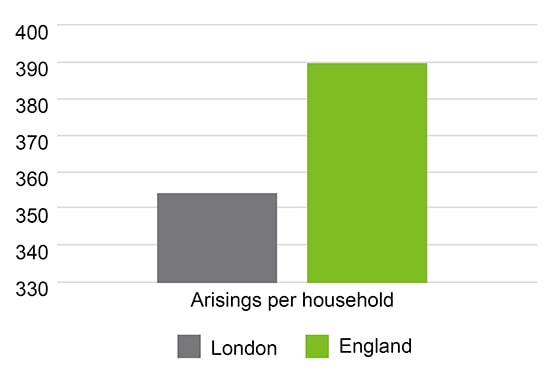
The decline continued a trend which was also seen in 2011/12, when Londoners produced an average of 373kg per head, compared to an average of 398kg for the rest of England. In 2012/13, London householders produced an average of 354kg of waste per person, compared to 390kg in the rest of England.
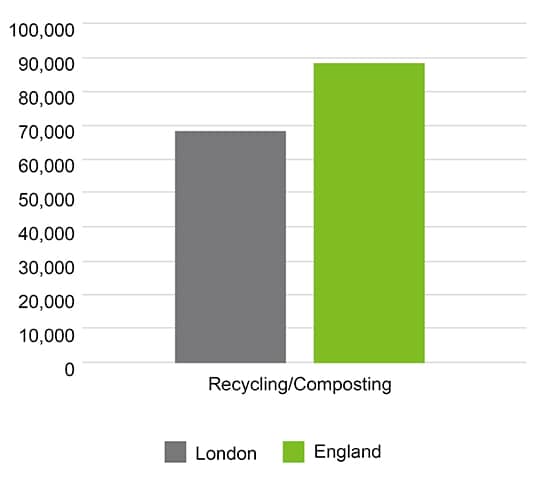
However, the amount recycled, composted or reused in London in 2012/13 remained comparatively low at 34%, a 0.1% increase on 2011/12.
Western Riverside Waste Authority, which accounts for an estimated 980,000 people across Wandsworth, Lambeth, Hammersmith & Fulham and Kensington & Chelsea, saw its total waste arisings fall from 393,021 tonnes in 2011/12 to 386,258 tonnes this year, collecting 320kg of household waste per person compared with 345kg last year. Elsewhere, the City of London, with approximately 4,400 households, collected just 4,006 tonnes, down from 15,506 tonnes.
Response
In response to the data, Western Riverside Waste Authority general manager Mark Broxup criticised traditional weight-based recycling targets as unfair, arguing they failed to recognise councils working to prevent waste further up the hierarchy.
The London Councils organisation has also published a member briefing on the state of household waste in London which analysed the impact of the Love Food Hate Waste and Flats Recycling Programme on municipal waste collection and treatment in the capital.
It suggested that the food waste initiative, which ran from October 2012 to March 2013, reduced avoidable food waste by 14%, from 2.6kg per household per week pre-campaign to 2.2kg post-campaign. Meanwhile, the flats programme, which was launched in July 2010, distributed more than 4.1 million to improve recycling services for 522,718 households (see letsrecycle.com story).
However, there were some exceptions to the decline in waste arisings. Tower Hamlets, with an estimated population of 254,000, recorded a slight overall increase of 102,487 tonnes up from 100,803 in 2011/12 while the City of Westminster, with a population of some 253,000, also saw an increase from 175,358 to 178,354 tonnes.
Problematic
Commenting on the statistics, Mr Broxup told letsrecycle.com: Weight-based recycling targets are problematic. They are based on perverse incentives that do not give a true picture of what authorities are doing to prevent waste arisings.
London gets unfairly criticised for its recycling rates when those recorded in other regions of the country are predominantly garden waste collections. London might produce slightly more residual waste than others but there are reasons for that such as tourism and population density.
Asked what Western Riverside was doing to achieve lower tonnages, Mr Broxup identified a combination of initiatives, including advertising campaigns, lightweighting, which affects both residual and recycling rates, and economic activity such as less free newspapers available in the capital.
He added: We encourage the waste hierarchy at every opportunity. We are actively part of the London Reuse Network and we have a workshop in Riverside for furniture reuse funded by LWARB. Given the modest amount of tonnage produced by reuse we understand in the long term there is probably more to be done with product design.
Record
The chair of London Councils transport and environment committee councillor Catherine West told letsrecycle.com: As the cost of living rises, councils are at the forefront of saving households money by encouraging people not to throw away so much, through campaigns like Love Food Hate Waste.
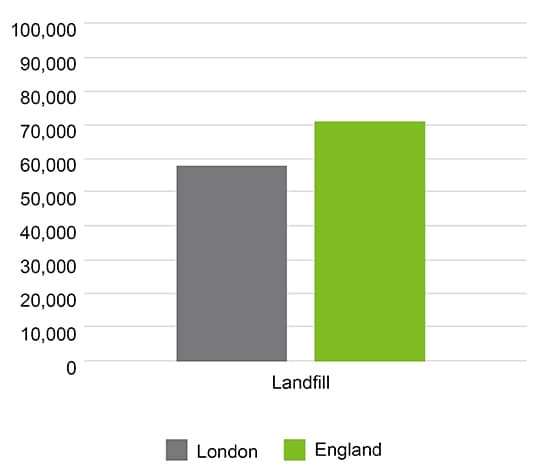
The latest government data shows that Londoners generate less waste than residents in any other part of England and the amount of rubbish London boroughs send to landfill reached a record low of 25.5%.

Register for free to comment