

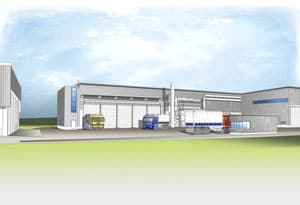
And, yesterday (March 30), the county council's development control and regulation committee approved proposals by Shanks to develop one of the facilities at Sowerby Woods Industrial Estate in Barrow.
Construction started on the first MBT plant at Hespin Wood in Carlisle in September 2009 at a ‘spade-in-ground' event attended by representatives from Shanks and Cumbria county council (see letsrecycle.com story).
The Hespin Wood facility is expected to be operational in 2012, while work is set to begin on the Barrow facility in the autumn with Shanks hopeful of having it fully operational by 2013.
Shanks has previously stated that solid recovered fuel (SRF) produced in the MBT process could potentially be used by local businesses as well as feeding the company's existing arrangements with kiln operators.
Commenting on the council's decision to grant permission, Marie Fallon, environment corporate director for Cumbria county council, said: “Getting the approval for this planning application is a big step in revolutionising waste and recycling services in Cumbria.
“Our contract with Shanks will massively reduce the amount of rubbish being sent to landfill and provide the county with a greener, more cost-effective system for dealing with residual waste for many years to come.”
Input
Each year the county council deals with around 300,000 tonnes of waste, with 120,000 to 130,000 tonnes-a-year set to be dealt with by the MBT plants, 150,000 tonnes recycled and the remaining 30,000 tonnes set to go to landfill as it cannot be recycled or dealt with by the MBT process.
In the agenda presented to the council's development control and regulation committee, it was outlined that the input for the Barrow MBT would be: 25,000 tonnes of municipal waste-a-year from Barrow; 36,000 tonnes-a-year from South Lakeland; and, 18,000 tonnes-a-year from South Lakeland.
However, it was indicated that these figures were “slightly higher” than annual waste figures for the three areas and had instead been included as a means of identifying the “worst case scenario” for the development. It is anticipated that the figures would decrease to 75,000 tonnes-a-year as recycling increased.
Sam Grant, Shanks operations director, Northern PFI, said: “The granting of planning permission is really great news for Barrow and Cumbria. Now, in conjunction with the sister site in Carlisle, Barrow can lead the way to a more sustainable future for dealing with Cumbria's waste and maximising its resources.”


Register for free to comment