



The date of the strategy's publication – next Thursday – was revealed to delegates at the CRN UK annual conference in Birmingham today (May 17) by Matthew Thomson, chief executive of London CRN.
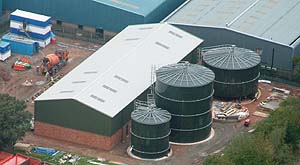 Greenfinch's anaerobic digester in Shropshire |
The new waste strategy had been delayed from last year because environment secretary David Miliband wanted a new focus on the potential carbon emissions savings that can be achieved through sustainable wastes management. (see letsrecycle.com story)
And, it is understood that Mr Miliband has taken an interest in anaerobic digestion plants operating in Germany, ahead of its release.
Anaerobic digestion
The process, which involves the liquidisation of wastes like food waste before it is broken down by bacteria in controlled levels of oxygen, has already been tested by Defra's Demonstrator Programme.
Support for anaerobic digestion looks set to come because it can reduce the emission of climate change-causing carbon dioxide in numerous ways.
Firstly by diverting waste from landfill, but also by creating renewable heat or electricity from resultant biogas to replace energy created from fossil fuels.
The use of solid or liquid digestate – the material left over after biogas has been generated – on agricultural fields can also reduce carbon emissions from the production of chemical fertilisers. It also acts to 'sequester' carbon by keeping it in the soil.
Greenfinch
Michael Chesshire, whose company Greenfinch runs one of Defra's Demonstrator Programme digesters in Ludlow, South Shropshire, said carbon was also saved because digesters are suitable for small-scale, local use, so waste does not have to be transported over long distances.
In a workshop at the CRN conference yesterday (May 16), he said a 10,000 tonne-per-year capacity plant could handle food waste from 60,000 households on a site of just half a hectare in area.
Mr Chesshire said economics would drive anaerobic digestion in this country – particularly the sale of digestate to farmers. “Farmers have had it easy so far because mineral nitrates have been so cheap,” he said. “But as the price of energy and carbon rises, so it will be more attractive to use alternatives.”
The Greenfinch digester in Ludlow initially took green waste and food waste commingled from households in the South Shropshire district. This was, however, a
“nightmare”, Mr Chesshire revealed, because so much green waste was arising compared to the richer more energy-efficient food waste.
| Related links: |
“We're now running it 100% on food waste, collected in Ludlow and Newtown – it's much higher quality, with less contamination,” he said. South Shropshire is sending its organic waste to the Bioganics in-vessel composter in Leominster.
Mr Chesshire said councils would be making a huge mistake collecting food waste together with green waste or cardboard, since they would be paying a premium for all of the tonnage to be treated under animal by-product legislation.

Register for free to comment