


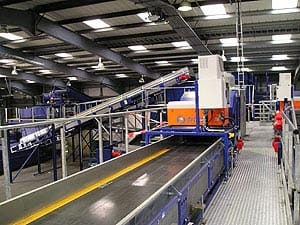
Community Waste, which runs the MRF in Milton Keynes, which is now capable of sorting 100,000 tonnes of mixed recyclables a year, said it has met with WRAP in the hope of developing an industry-wide specification for MRF-sorted paper.
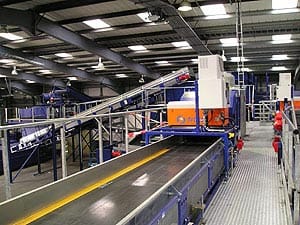 Community Waste's Milton Keynes MRF |
The company hopes a formal grade for MRF-sorted paper would demonstrate that its MRF, which uses state-of-the-art technology such as eddy current separators and optical sorting technology, is not a “second class citizen” in the recovered paper chain.
The move is a direct response to the Real Recycling Campaign, which has been backed by paper reprocessors as an attempt to stop the rising interest amongst councils of commingled recycling collections (see letsrecycle.com story).
Richard Cutts, director of Community Waste, said at an open day yesterday: “We are working with WRAP to produce a grade of paper to a specification regardless of its origin. It is to prove that we do achieve a standard which can be sent to any paper mill and there no issues with materials being produced in MRFs like this.”
“We don't want to be seen as a second class citizen just because we are a MRF. It is about the quality of the plant and the material it produces,” he added.
Processing
Community Waste, a joint venture between Doncaster recycling firm Cutts Brothers and paper suppliers Atlantic Paper Ltd, has upgraded the Milton Keynes plant since it suffered a fire in 2005 (see letsrecycle.com story).
The facility now sorts materials including paper, plastic and cans collected in the Milton Keynes and surrounding areas.
Its sorting technology includes a state-of-the-art ballistic separator from Germany, which separates paper from plastics and metals through the different way that the materials bounce.
Community Waste claims that these processes, combined with running the plant relatively slowly, help to achieve very low contamination rates – including a 0.01% rate for newspapers, periodicals and magazines sent for reprocessing in China.
Community Waste said economies of scale means it can charge a relatively low gate fee of around 10 a tonne.
Mr Cutts said: “I think single stream recycling is the way forward from a cost perspective and we can meet various quality thresholds which make it the logical way forward.”

Register for free to comment