


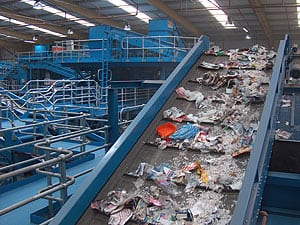
Under the campaign launched last week, reprocessors have linked up with the community sector and pressure group Friends of the Earth to demand that councils collect recyclable materials separated at the kerbside (see letsrecycle.com story).
 . Collecting recyclables commingled for sorting at a MRF can “by and large be collected and processed more cheaply than source segregated”, according to Shanks |
Waste firm Shanks, which is backing the Environmental Services Association's Recycling Registration Scheme for MRFs, said this week that forcing councils to adopt source-separated collections would prove costly to councils.
Shanks' director of material management Paul Dumpleton said: “What I think is happening here is an attempt to raise the quality standard in the UK to a level that is disproportionate to other countries without paying a premium for the product.”
He added: “I do think it is important for the country to have a strong reprocessing infrastructure but we can not do that by putting additional cost in the collection and processing structure.”
Quality
Under the Campaign for Real Recycling, reprocessors including the three UK newsprint mills Abitibi-Consolidated, Aylesford and UPM Shotton claim that co-mingled collections are leading to poor quality recyclate feedstock.
The companies backing the campaign – which also include aluminium recycling firm Novelis and recycling box manufacturer Straight plc – said that commingled material is now reaching a point where it is not good enough.
Mr Dumpleton agreed that the principal of separating recyclable materials at the kerbside was a good idea and agreed that the waste management industry had a responsibility to produce recycled material that was fit for market. However he said forcing a source-separated approach was like “rowing against the tide”, and would prove to have limitations for councils in certain areas.
The Shanks director of material management claimed that any areas of concern were already being addressed under the Recycling Registration Scheme which seeks to certify the quality of MRF material (see letsrecycle.com story).
He said: “The fact is that the drive for increased recycling rates is pushing up local authorities to maximise the volume of material collected at the kerbside. Commingled can offer a wider ranger of collected products and can by and large be collected and processed more cheaply than source segregated. It is also true that in many cities a commingled collection is far more appropriate purely for the benefit of logistics.”
Mr Dumpleton concluded: “Like it or not, legislation has stimulated the demand for additional collection in the UK without paying due heed to the end market situation.”
Paperchain
Meanwhile, paper industry recovered paper campaign PaperChain this week welcomed the Campaign for Real Recycling and its call for separate material collections for promoting recyclate quality.
Its chairman Martin Green said: “UK paper reprocessors are seeing some very poor quality recovered paper and board coming into the market and are unwilling to take the risk of using this material because of the negative impacts on the paper making process.”
| Related links: |
The organisation, which is part of the Confederation of Paper Industry, explained that mills could not risk closing their machines due to raw material quality problems and were less willing to take material from co-mingled collections- much of which is subsequently sent to markets abroad.
Mr Green said: “Paperchain has serious doubts as to the long term sustainability of the market for low quality recovered paper, as overseas reprocessors will suffer similar process issues. There is also a risk that the material is being shipped in breach of the EU Waste Shipment regulations because the quality can be so poor.”


Register for free to comment