



Investors envisage new British recycling infrastructure lasting for decades and therefore need a long term signal
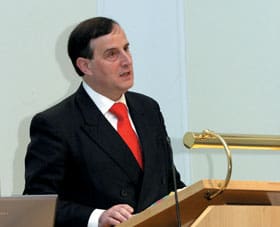
Dirk Hazell, ESA
Responding to the announcement yesterday (April 22) that the tax would rise by £8 a year for three more years (see letsrecycle.com story), trade associations and industry representatives broadly welcomed the move.
However, the Environmental Services Association (ESA) and the Local Authority Recycling Advisory Committee (LARAC) – which represents local authority recycling officers – claimed that the “medium term” plans did not offer any greater assurances to long term investors than the existing escalator which ran until 2010/11.
Dirk Hazell, chief executive of the ESA, said: “The ESA would have preferred the Government to give a signal on future landfill tax levels going beyond the three year landfill tax escalator announced yesterday.”
Pointing to a commitment by the Conservatives to “put a floor” under the level of Landfill Tax until 2020 (see letsrecycle.com story), Mr Hazell added: “While the announcement will undoubtedly encourage British businesses to think much harder about recycling far more, investors envisage new British recycling infrastructure lasting for decades and therefore need a long term signal of the type already given by the Shadow Chancellor.”
The sentiments were similar to those expressed by the Local Authority Recycling Advisory Committee (LARAC), which claimed the Tax should reflect longer term aspirations of the infrastructure development.
Andrew Craig, principle policy officer at LARAC, told letsrecycle.com: “I think we need to know what it is going to for probably the next ten years to get more reasons for investment in the industry and so these short term policies, although they are better than nothing and we now know what is going to happen, I think we want longer plans.”
Certainty
Others in the waste and recycling sector were more vocal in their support for the fact that Landfill Tax had been addressed by Chancellor Alistair Darling, after continued calls had been made in the lead up to the Budget for some indication of the future of the escalator (see letsrecycle.com story).
Steve Lee, chief executive of the Chartered Institution of Wastes Management (CIWM), said: “Greater certainty about the future of Landfill Tax is clearly one of key headlines for our sector, and we now have what the CIWM and many in the industry have been asking for – a medium term plan that takes us to 2013 and allows businesses, local authorities and the waste sector to plan effectively for the delivery of future services and treatment infrastructure.”
“A rate of £72/tonne tax plus the gate fee is generally viewed as being the level needed to keep us moving up the waste hierarchy. We also welcome the consultation on modernising the landfill tax, which should provide greater clarity in a number of important areas, including the re-examination of wastes that should only attract the lower (inactive) rate,” he added.
The measures were also supported by some operating in specific material sectors. One senior UK paper recycling sector director told letsrecycle.com: “The increase in landfill tax should divert many more tonnes of material. I think we are all on board for that, we do need a market for the materials that are collected and an uplift in the economy is essential.”
AD and IVC
There were also mixed reactions from industry following the announcement of £10 million in funding for anaerobic digestion and in-vessel composting (see letsrecycle.com story).
Welcoming the move, Mr Lee said: “The announcement of £10 million for anaerobic digestion (AD) and in-vessel composting is also encouraging. As chair of Defra's AD Task Group, I believe it will help stimulate development of this technology, which clearly has a role to play in the future.”
Conversely, LARAC questioned why the government had only offered £10 million in funding despite outlining organic waste treatment methods as a means of increasing the UK's recycling performance.
Mr Craig said: “£10 million seems like a drop in the ocean. I think, in general, AD is the government's big idea and I think the government could help more. We support the development of AD and, I think, the industry wants a long term, low risk economic environment.”


Register for free to comment