


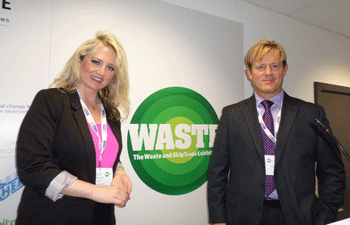

A meeting between HMRC and the skip hire industry in Manchester led to a heated debate over the proposed 10% threshold set for loss on ignition testing yesterday (June 3).
Representatives from Her Majestys Revenue & Customs attempted to allay concerns over the new landfill tax boundaries for trommel fines at a panel session at SkipHireMagazines Waste 14 exhibition, held at Salford City Stadium.
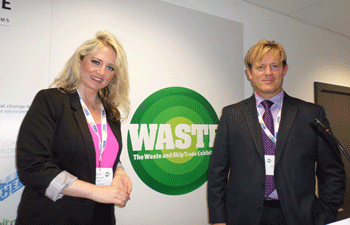
The panel also included Sam Corp, head of regulation at the Environmental Services Association, and Jenny Watts of the United Resource Operators Consortium who both provided input on the proposals.
Under plans launched for consultation published by HMRC on Monday (see letsrecycle.com story), from April 2015 landfill operators will be required to perform LOI tests for every 1,000 tonnes of waste received from an individual waste plant.
And, under the rules, customers must ensure any waste load hoping to meet the 2.50 lower rate of landfill tax has a loss on ignition of 10% or less or face being charged the standard rate of tax, which currently stands at 80 per tonne.
Inconsistent
But the proposals came under fire from the sector yesterday, with some skip hire firms arguing that LOI testing is too inconsistent to provide a measure of the inert materials present in an individual load.
Firms that already conduct LOI testing also voiced fears that there was no way in which to challenge a decision made by landfill operators, while cross-contamination could spoil a sample once it has arrived onsite.
Wastecycle recycling director Kevin Wilcockson cited his past experience sending fines off for LOI testing, and argued that time and again, results come back completely different from one test to another. He added that the laboratories are not always perfect.
‘HMRC took the view that 10% is generous. They are not open at this moment in time to have any tolerance. I think there was an opportunity to have a higher percentage in the interim period but I think that door may now be closed.‘
– Jenny Watts, United Resource Operators Consortium
Another industry professional said: The threshold needs to be at 15-20%. Government seem to think we are trying to get one over on them, when all we are trying to do is recycle. If you get this wrong you will cause mass unemployment.
HMRC should explain to us what we have to do. You cant just write a decision and walk away.
‘Generous’
Defending the proposals, Claire Williams of the HMRC argued the 10% threshold was generous and would allow for a smaller amount of contamination.
On the issue of bias sampling, she said: Customers will need to show landfill operators that a load that does not pass the test is an atypical load, and landfill operators will have to take that into account.
And, Mr Corp added that there was no incentive for a landfill operator to charge their customers the higher rate of tax, as all proceeds would go to HMRC.
Compromise
But, in an earlier conference session, Ms Watts of UROC admitted that setting a higher threshold of 15% would have been a reasonable compromise.
She said: 15% would be reasonable. It would give us time to implement it into the workplace and invest in new technologies. A lead in time of 12-24 months would also have given us time to get up to speed.
HMRC took the view that 10% is generous. They are not open at this moment in time to have any tolerance. I think there was an opportunity to have a higher percentage in the interim period but I think that door may now be closed.
She added that 10% should be 10%, and further testing for customers producing an LOI 8% or more would lead to unnecessary confusion.


Register for free to comment