

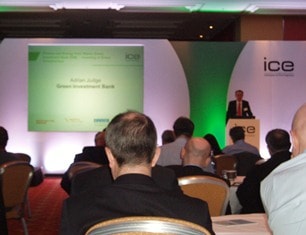
Mr Judge suggested that he thought the challenge for the private sector was that the waste industry could sometimes be a complicated area to invest in.
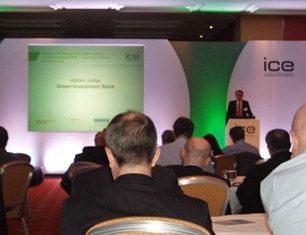
However, Mr Judge added that he was optimistic that the private sector would begin to invest more in waste infrastructure as clearly good investment opportunities are out there.
Mr Judges comments came yesterday (March 21) during his presentation, Finance and Energy from Waste: Green Investment Bank Investing in Green Infrastructure, at the Energy from Waste conference 2013 in London, organised by the Institution of Civil Engineers (ICE).
Giving an overview and update on financing for waste infrastructure at the GIB, which was set up in October 2012 (see letsrecycle.com story), Mr Judge said: Our real mandate is to prove that you can make money by investing in green projects.
‘The appetite from the private sector for investing in infrastructure projects seems to have reduced a little over the last 12 months.’
Adrian Judge, managing director of waste and bioenergy, GIB
We want to avoid crowding-out the private sector so we are not seen to be just investing in all the best projects. We aim to crowd-in private sector capital. It is all about trying to get some confidence in investing into the UK market.
However, Mr Judge said: The appetite from the private sector for investing in infrastructure projects seems to have reduced a little over the last 12 months.
Clearly it is a potential barrier to investment, but that is part of the reason the GIB was set up in the first place, he said. I am optimistic as clearly good investment opportunities are out there. The challenge for these private institutions is that waste is a sector that is complicated to invest in.
He added: I am moderately optimistic investor interest will improve but it is not going to be easy.
GIB investments
The GIB was set up by the government with an initial capital allocation of 3 billion to invest in various green projects such as offshore wind, waste and bioenergy, non-domestic energy efficiency, and support for the Green Deal. The aim of the bank is to help the government meet sustainability targets while encouraging investment and growth in green projects.
Reflecting on investments made by the bank since its inception, Mr Judge said: There have been various successful projects and unfortunately one or two failures. The problem is that people always remember the failures rather than the successes one failure is worth 10 successes in the eyes of the public.
He added: We have learned that we cannot be reactive to projects we need to be active to find some of these projects and make them happen because there are some out there that just need a bit of movement to get them going.
Related Links
Mr Judge said that he felt it was important to consider the merits of a possible investment over the lifetime of the project and that the GIB, although an independent for-profit institution, had a government mandate to be a responsible investor.
As part of this, he explained, while GIBs finance documents for projects could sometimes be complicated for firms, they were not meant to be a barrier to investment but to encourage good practice in the companies.
Commenting on future GIB investment projects to be announced, Mr Judge said: We are having a lot of conversations on projects behind the scenes that we are clearly not allowed to make public at the moment.

Register for free to comment