

Proposals distributed to schemes yesterday by the Department for Business, Innovation & Skills (BIS) show that government officials favour a target based on the average growth or decline in tonnage of WEEE collected since 2010 for each category of EEE.
The target stipulates the amount of evidence that schemes will be required to collect for each category of WEEE generated. Overall, that will mean that schemes will be obligated to collect around 508,000 tonnes of WEEE in 2015 – 18,225 tonnes higher than the target set for schemes in 2014.
According to BIS, the overall target is significantly above the collection levels necessary to achieve the EU Member State target of 484,661 tonnes for 2015.
The Department also considered setting the targets based on the amount of WEEE generated solely in 2014, but opted to use the average since 2010 due to this method being ‘more robust’.
Dual use WEEE
The target for small mixed WEEE is likely to be of particular interest, having been set at a higher level than in 2014 despite a shortfall in the amount collected during this period. However, BIS anticipates that due to changes in the guidance on the collection of dual use WEEE, which has been widened to include some WEEE from businesses, more small mixed WEEE is likely to be available to schemes in 2015.
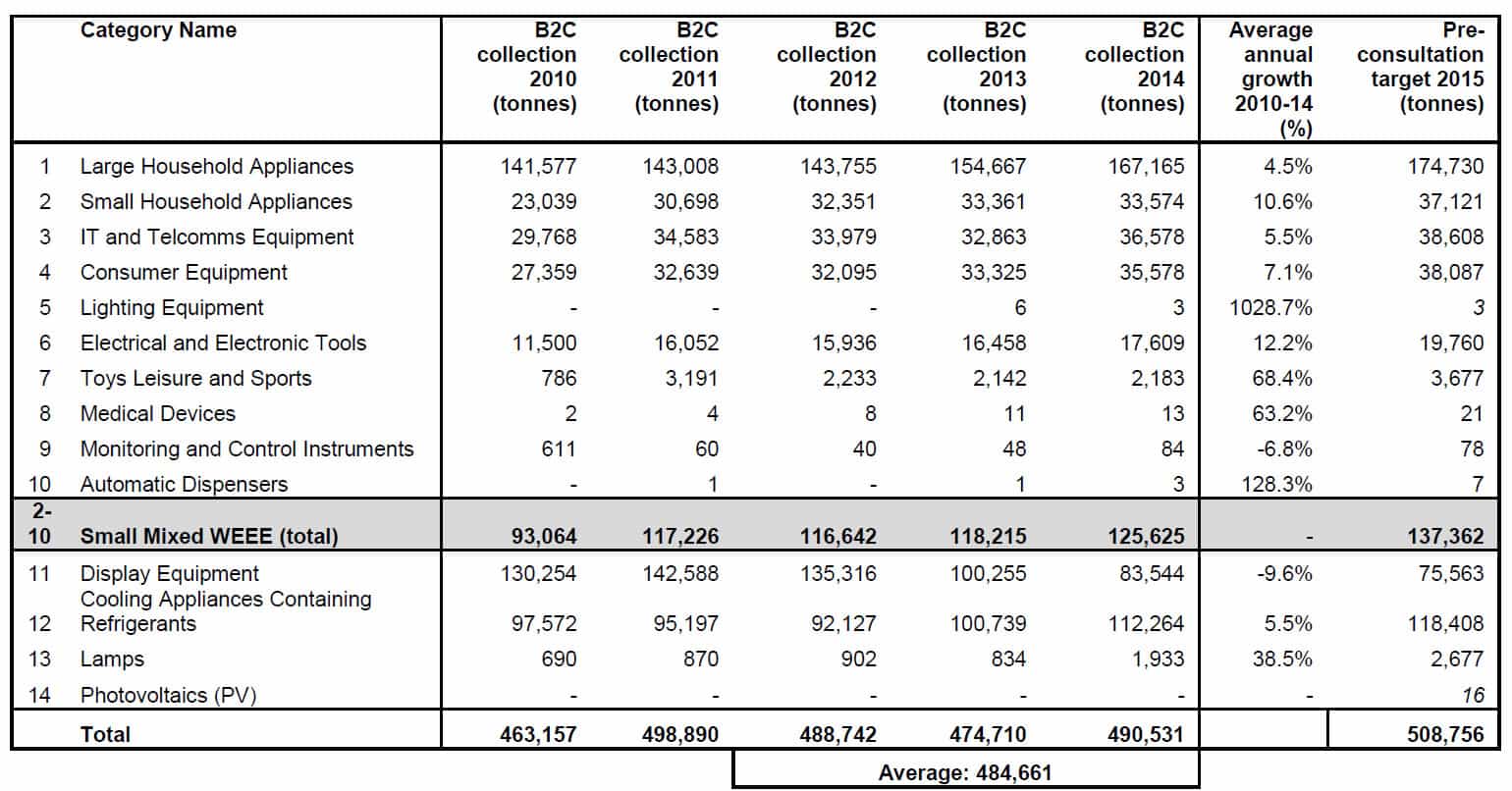
In its documents outlining the proposals, BIS stated: “The proposed target setting methodology sets an overall target of 137,362 tonnes for small mixed WEEE in 2015. This is an uplift of 11,737 tonnes compared with 2014 collections. We believe this would be an extremely challenging target to meet through traditional household WEEE collection routes.
“However, we do not propose to adjust this target given that we anticipate some PCSs may seek to achieve their targets by supplementing their existing arrangements with collections of dual use WEEE from non-household end users in 2015.”
Compliance schemes have been asked to provide their views on the proposed target levels by 5pm on March 10.

Register for free to comment