


Speaking at a seminar organised by waste management firm UKWSL last week in Coventry, senior EA official David Bunt explained to delegates that he is getting nearer to producing plans for regulating the new rules in England.
[testimonial id = “32” align=”right”]
“I am talking to local authorities and commercial collectors”, he explained. “Government has not produced lots of guidance and has therefore passed responsibility for the regulations to producers and the commercial waste companies. It is looking for little cost to be passed to collectors and a light touch approach from us.”
Hierarchy
Mr Bunt said that the regulations “complement the waste hierarchy…. the most important thing is that there is a requirement to collect separately at least those four main streams, when it is necessary to recover waste and to produce a high quality recyclate and when it is technically, environmentally and economically practicable to do so. Now both of those are open to interpretation, both necessary and what are high quality recyclates and TEEP are open to interpretation.
“If we had the time and resources we could produce a document several hundred pages long for every permutation but we don’t have the resources and instead we will be asking you and the collection authorities to demonstrate that you have applied those two tests. And that if you have good record keeping that shows you have applied that and that you can justify that ultimately in a court of law you can show you have been doing the right thing.
 “Ultimately it is up to the collection authorities to apply those tests and record them.”
Private
Mr Bunt emphasised that the rules apply to both public and private collections.
And, he hinted at a reluctance within the waste management industry to produce a route map for the commercial sector in the way that the local authority sector has done for councils.
He said he had been at the Environmental Services Association recently for a meeting. “Some of you may have seen the local authority network have produced a route regulation roadmap, a helpful and lengthy and detailed document. It helps local authorities work through the two tests. At present the commercial sector are saying it is too detailed, and too long for them. But, I am saying fine, why don’t you produce something that you think is suitable?”
Mr Bunt explained that councils would do well to look at the route map. “If people are applying the route map rigorously they will be showing a good high regard and assurance for acting reasonably.”
Indicators
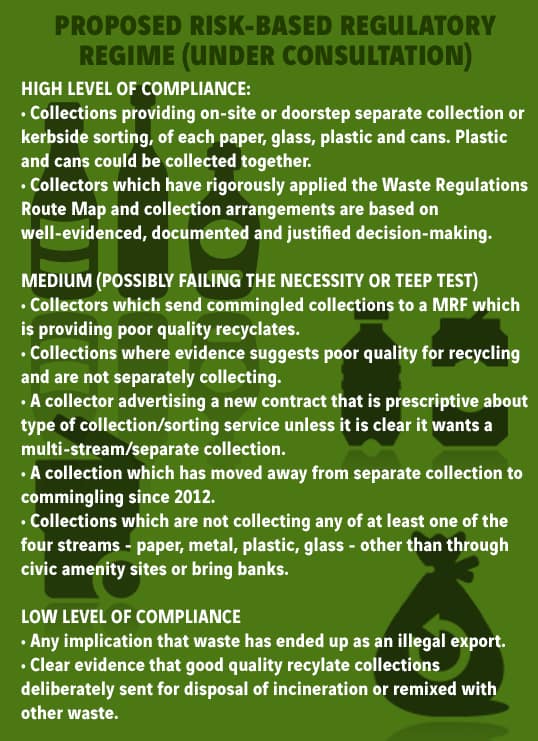
He went on to say that the Agency has highlighted a high, medium and low set of indicators by which it will apply the regulations: “So at the top we are expecting 75% of collectors to be in this bracket and doing good separate collections and applying the route map and not expecting to talk to these people at all.
“At the lower end, which we are interested in, is where people are acting illegally, where waste is ended up as illegal export or evidence that good quality recycling is being deliberately remixed or sent for disposal.”
He also said that the Agency will be looking at data sources and WasteDataFlow. “We are also starting conversations. For example, it might be that you are in the middle of a seven year contract and say it is going to cost us millions to change a seven year contract and we will say that’s reasonable, and we’ll come and talk to you in three years’ time.”

Register for free to comment