


The construction sector is no stranger to waste. From demolition arisings to offcuts generated on site, material loss has long been treated as an unavoidable by-product of building at scale.
But as pressure mounts to decarbonise the built environment, the sheer volume of construction waste is leading more businesses to target waste reduction strategies, such as increasing their use of recycled materials.
The struggle to scale construction recycling
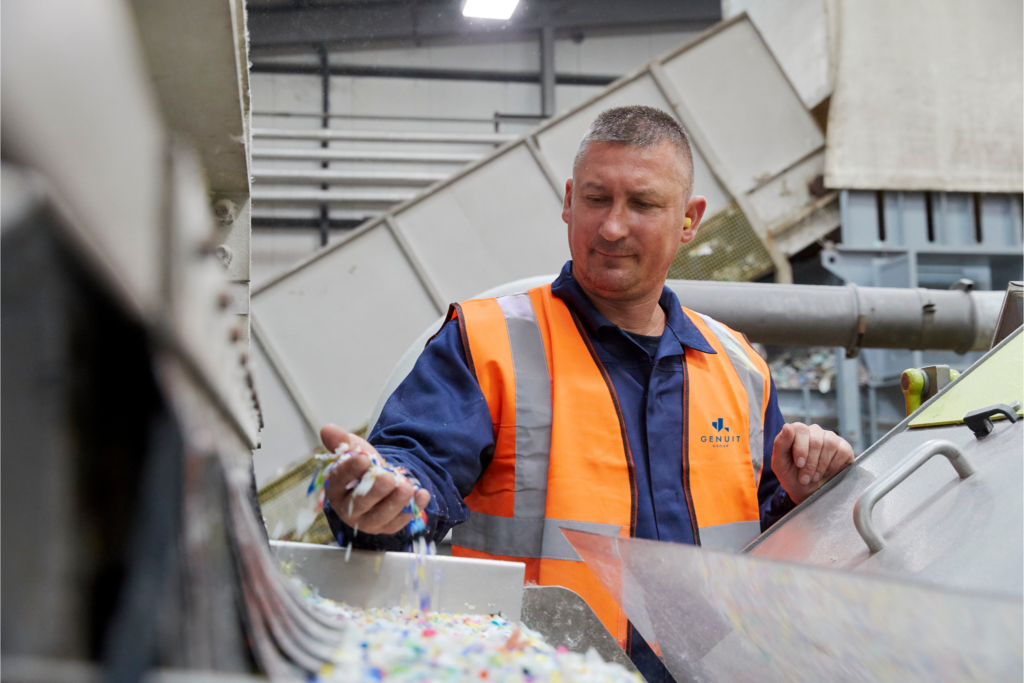
One such company is Genuit Group. The business supplies drainage, water management, ventilation and heating solutions across the built environment and is one of the construction sector’s biggest consumers of polymer materials.
Adam Pointon, Materials Development Manager at Genuit Group, explained: “On average, we’re consuming about 50% recycled material on average across the polymers we consume.
“But with how the recycling industry and sector are at the moment, that’s looking more and more challenging as time progresses.”
That challenge is not a lack of ambition. According to Pointon, recycled material was once seen primarily as a cost-saving option. Today, it is typically more expensive than virgin polymer.
Across the sector, demand for recycled polymers is increasing as companies pursue their own sustainability targets. But this growing demand is colliding with a recycling system that is struggling to deliver sufficient volumes of suitable material.
Supply shortages and oversea processing
One of the most immediate barriers facing construction manufacturers is availability.
According to Pointon, around half of the UK’s recyclable plastic material is exported, processed overseas – often at lower cost due to cheaper energy and labour – and then sold back into the UK market.
While this may make short-term economic sense, it undermines domestic recycling capacity and worsens the carbon profile of recycled materials.
Pointed added: “The transport carbon of that material is very important to us. After all, stuff that looks sustainable as a recycled material then suddenly doesn’t become sustainable if we’re shipping it from one side of Europe or outside of Europe.”
Lost plastics recycling capacity
At the same time, recyclers themselves are under pressure. High energy costs and operating expenses have led to a wave of closures across the UK and Europe, including the closure of Viridor’s Rochester and Avonmouth sites, and Vanden’s Whittlesey site.
According to figures from Plastic Recyclers Europe, recycler shutdowns over the past year have resulted in the loss of around one million tonnes of recycling capacity.
For manufacturers already struggling to secure feedstock, this contraction has further tightened supply.
Where material is available, quality becomes a persistent challenge.
Recycling collection systems in the UK remain fragmented, with different local authorities operating different collection rules and accepted materials. The result is geographically inconsistent feedstock entering the recycling system.
Pointon explained: “Every local Council I know does the collection of material are completely different.
“Therefore, everyone in different geographical regions has different quality supplies going into the recycling.”
For construction manufacturers, this inconsistency presents a major obstacle. Due to the strict performance and safety standards in the sector, variability in recycled material quality makes it harder to maintain product compliance without extensive testing, reformulation and investment in research and development.
Regulation for the construction industry
Policy has helped accelerate the use of recycled plastics in some sectors, but for construction it has also exposed misalignment.
Measures such as the Plastic Packaging Tax have successfully driven demand for high-quality recyclate into packaging, particularly food-grade applications.
However, the economic signal created by the tax is not always strong enough to justify major investment in product redesign or material innovation.
Pointon explained: “There are a number of people that are still just paying the tax because it’s not high enough of an incentive.
“Buying recycled material, going through the R&D process of doing the test and the trialling, potentially investing in new equipment, hiring new staff with the capabilities to process and understand and process the material – that’s all far more expensive than potentially going ‘we’ll pay a little bit of money per tonne of material’.”
European restrictions on lead in recycled PVC have also introduced restrictive, product-specific closed-loop systems to manage hazardous substances. These restrictions risk sharply reducing material availability for construction, which relies on a limited number of high-quality recycled streams.
According to Pointon, the solution lies in designing policy around how construction actually works. Rather than narrow product-by-product loops, he argues for sector-wide circularity, keeping construction materials circulating within construction, while packaging materials stay within packaging.
He added: “We don’t want to lose the supplier that we do have access to. Regulation is needed, and regulation needs to be introduced.
“But it doesn’t need to impact us negatively when it comes to the material that we can access.”

Subscribe for free