

The flagship energy recovery facility of waste firm Veolia Environmental Services officially opened on Tuesday in Hampshire, with assurances that it would not compromise local recycling rates.
The plant has the capacity to burn 165,000 tonnes of household black bag waste each year to produce 17 MW of electricity. Veoila exports most of this to the National Grid, providing power to 22,000 homes and the remainder is used to power the Marchwood facility.
CHP
Veolia said it opted for electricity production only, rather than generating combined heat and power (CHP), because there are no residential developments close enough to Marchwood to use the heat.
It said the technology was in place at the site to use the heat if suitable users became available.
The Marchwood facility is Veolia's third energy recovery plant in Hampshire – the others are in Portsmouth and at Chineham, near Basingstoke. The three have been built to cope with the forecasted amount of non-recyclable municipal waste diverted from landfill. There is small scope to burn construction waste.
It was described by Veolia's UK chief executive Jean-Dominique Mallet as a “unique, state-of-the-art facility” which was making a significant contribution to climate change because it was not burning fossil fuels.
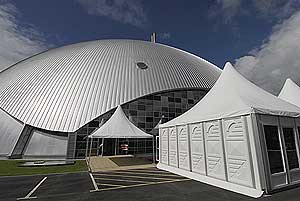
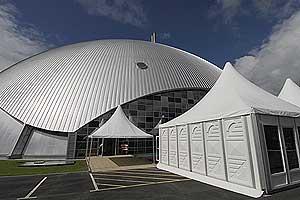
The site is built in the shape of an aluminium dome designed by architect Jean Robert Mazaud. The design was selected to make “people proud of industry” and “show them how exciting waste can be”.
The dome is 110m metres wide and 36 metres high, with its two chimney stacks reaching 65 metres high.
Process
The waste is burned to produce gas which passes through two boilers, heating water to create steam. A turbo-generator, powered by the steam, produces electricity for the National Grid.
The facility is said to differ to traditional incinerators because it does not have a cooling tower. Water from the nearby sea is used instead to lower temperatures on boilers and the generator.
The gases used in heating are injected with lime milk to neutralise acid gases while activated carbon removes dioxins. These cleaned gases are released into the atmosphere through the chimneys, leaving behind an air pollution control residue, which after undergoing hazardous waste treatment is landfilled.
The other by-products of incineration are ash and metal, with the ferrous metal taken out and recycled. The ash is presently being sent to landfill although a planning application has been submitted to build a plant in Hampshire to recycle the ash into road fill.
Veoila and the Hampshire councils involved in the project have said that the facility, which has been producing electricity for six months, will contribute to Hampshire's “joined-up approach” to increase recycling and landfill diversion efforts.
Recycling is currently at 33% with plans to increase it to 40% and landfill diversion rates are at 85%, with plans to increase this to 100%.
Hampshire county council's executive member for environment Councillor Mel Kendal, also speaking at the facility's opening, said the county was “looking forward to the day when we can eliminate landfill disposal” from Hampshire's waste infrastructure.
He added that the new English Waste Strategy endorsed Hampshire's waste infrastructure by placing emphasis on increasing energy taken from energy-from-waste (see letsrecycle.com story).

Subscribe for free