


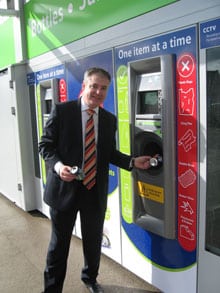

Developed by Norwegian technology firm Torma, the machine is intended to make recycling easier for visitors to the supermarket and also help increase recycling rates.
Speaking at the launch, Mr Lochhead said: “I am delighted to open this automated recycling centre and try out this new facility for myself.”
“Tesco's commitment to encouraging their customers to recycle is to be applauded and I am pleased to hear of plans to introduce this facility to further stores,” he added.
The initiative, which has backing from Waste Awareness Scotland, is being undertaken as part of multi-million pound investment in a nationwide green campaign across Tesco's stores in Scotland, which is set to see three further automated recycling machines installed in Ayr, Alloa and Queensferry.
Convenient
Louise Goodland, spokeswoman for Tesco claimed that the machine would make recycling “more convenient” for customers and said: “Recycling is a key issue for our customers and as a responsible retailer we are committed to helping our shoppers adopt green habits.”
The system uses laser sensors to scan deposited material, which is then transferred onto a conveyor system and crushes or shreds the item prior to it being deposited in collection bins. Shoppers receive Green clubcard points in relation to the amount of material they deposit, with two aluminium cans being worth one clubcard point.
Tesco claim that compacting the recycled material in the machines means that collection vehicles need to make fewer trips to sites, and this could help to reduce the carbon footprint of its overall recycling operations.
The recycling machine is based on an existing model currently being employed by a number of European countries and was first installed in the UK by Tesco in Winchester in 2004 (see letsrecycle.com story).
Waste
The introduction of the facility comes in the wake of support from the Scottish Government for the use of return and deposit schemes as part of its ambitious Zero Waste policy, which intends to reduce waste to landfill to 5% by 2025.
Mr Lochhead said: “It is always encouraging to see projects and initiatives which directly contribute towards our vision of a zero waste society. It is vital that, for the sake of future generations we reduce our consumption of non-renewable resources, and lessen our impact on the wider environment.”
When Zero Waste legislation was first mooted in July 2008, Mr Lochhead claimed that use of “high-tech reverse vending technology” could help to double the amount of glass and plastic bottles currently being recovered in Scotland (see letsrecycle.com story).
The Scottish Government's support for reverse vending and deposit schemes comes despite a Defra research project published in December 2008 which claimed that while deposit schems could divert material from the kerbside, the collection infrastructure and would need to be very carefully designed.
The 29-page report claimed in its conclusion: “It is not disputed that a deposit scheme would increase recycling, but alternative schemes could achieve the same or better results at a lower cost.”
Meat
The announcement of the deposit scheme comes alongside an agreement being signed between Tesco and renewable energy company PDM Group for the disposal of the store's meat waste to go into energy generation.
The deal, which comes as part of Tesco's pledge to divert 95% of waste from landfill by the end of 2009, is set to see 5,000 tonnes of out-of-date meat used to generate energy in Doncaster-based PDM Group's biomass facility.
Energy generated from the process is then either going to be sold to the National Grid or used in PDM's facilities.

Register for free to comment