



Transport for London (TfL) said this week that waste represents 8% of all freight transported through the streets of London, and that using waterways instead could cut emissions by around 80%.
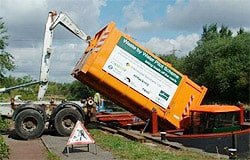 The transfer of collected waste to canal barge is being tested in the London boroughs of Hackney and Haringey |
A strategy called the London Freight Plan is currently being developed which aims to reduce the congestion on London's roads.
TfL's waste freight co-ordinator, Paul Dumble, said on Monday that as part of the plan, the West London Canal and River Lee was identified as particularly suitable for ferrying waste.
He said consolidation centres in the north, near the M25 and in the south, near the River Thames, could be set up to link the canals up to other transport links.
Speaking at a London Remade local authority networking event, Mr Dumble revealed that an inter-modal waste collection system is now being trialled in Haringey and Hackney. The system allows waste containers to be easily transferred between collection vehicles, flat-bed road haulage vehicles, rail or canal barges.
Transport for London has put 500,000 towards the development of the German-made multi-modal refuse collection vehicle (MMRCV), and is also putting 900,000 towards researching the development of the canal network.
” If we don't get this opportunity to move five to 10 million tonnes of waste on our canals in the next five years, we are never going to get them down our roads. “
– Paul Dumble, TfL
Challenge
Mr Dumble said the real challenge now was to develop the canal network – particularly in establishing loading and unloading facilities.
He said: “The CrossRail project and Olympics offer a unique chance to push forward canal infrastructure – billions of pounds are being spent, and there are opportunities to move supplies and waste along the canals.
“If we don't get this opportunity to move five to 10 million tonnes of waste on our canals in the next five years, we are never going to get them down our roads because they are going to become blocked,” Mr Dumble warned.
Costs
The TfL waste freight co-ordinator said the development of canalside loading facilities would cost in the region of 2 million per site, with operating costs in the region of 200,000 per year.
| Related links: |
He said the project would need the canal network to be assessed, with bridges and clearance issues reviewed and wharves developed.
Mr Dumble claimed that developing the canals in London was “probably the biggest single project to reduce London's CO2 impact”. He said: “Very often waste transport is trivialised because transporting waste creates 20 times less CO2 than processing it.”

Subscribe for free