

Speaking at a seminar on the new regulations at an event in Coventry last week, Andrew Beighton, commercial services manager at Nottingham city council, said that the authority was considering having a caddy for householders to put glass in and then this would be placed on top of the 240 litre bin used for collecting recyclables.
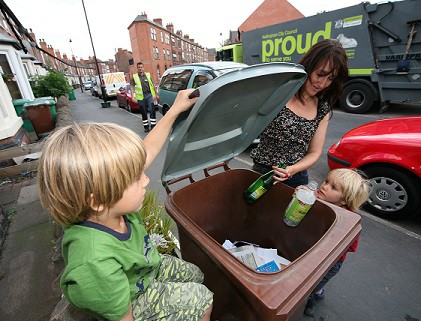
Addressing delegates at the event which was organised by Newark-based waste management firm UKWSL, Mr Beighton said: “We have a struggle with getting residents to actually put the bin out. A lot of people don’t have bin stores and they would struggle even more with having to deal with four bins. Some councils do have lots of bins but there are a lot with no space, they don’t have room so we have to bear all this in mind.”
Simple
The Nottingham officer explained that councillors did not want lots of bins and were aiming to keep recycling simple. “Councillors have said separate bins would be too complicated, they want everything in one bin. I am sure every local authority is going to have the same argument. As we see it, either glass or cardboard will be separated for collection. We are looking at a domestic caddy on top of our 240 litre bin depending on the amount of glass.”
The authority’s thoughts were endorsed by senior Environment Agency official David Bunt, environment and business manager, who was also speaking at the UKWSL event. Mr Bunt is in charge of shaping the Agency’s stance on regulating the separate collection rules.
He remarked: “The environment minister, Lord de Mauley, wrote that with separate collections, at the very least we expect the separation of glass and paper.”

Explaining in more detail the Agency’s position on glass, a draft guidance note says: “The minister, Lord de Mauley’s letter to local authority organisations in October 2013, said that in circumstances where glass shards cannot be kept out of the paper stream, or when low quality mixed glass is produced which needs further sorting and makes it uneconomic for re-melt applications, glass should be collected separately wherever it is practicable to do so. That means testing the market to be clear about comparative costs and keeping a good audit trail of the evidence and analysis behind any decision to co-mingle – or to not recycle all four materials.”
Glass
Mr Beighton said that the biggest concern that Nottingham had at the moment with regard to the new regulations, was glass although he suggested an alternative approach might be to collect paper and card separately. “Sometimes glass causes problems going into the MRF. Could we get a higher quality material if we collect it separately, or alternatively collect it with plastics and cans and maybe instead as an alternative we take the card out? There are various permutations to consider. We are nervous about compliance and we could get someone knocking on our door. We’re really nervous of not doing anything – some local authorities will take it with a light tough and others will take a closer look.”
And, he added: “If we did collect glass separately, how will we pick it up? Currently it all goes in one vehicle. There are options for side loading but we would have to look at the impact on our fleet.”


Subscribe for free