

Council partnership for foil recycling awareness campaign
Preston city council announced the rollout of a programme promoting aluminium recycling, including clean foil trays, wrapping foil and empty aerosols.
The campaign, titled ‘Clean Me’, will see creative advertisements placed on billboards, buses and bus shelters across the city. It is run by the Aluminium Packaging Recycling Organisation (Alupro).
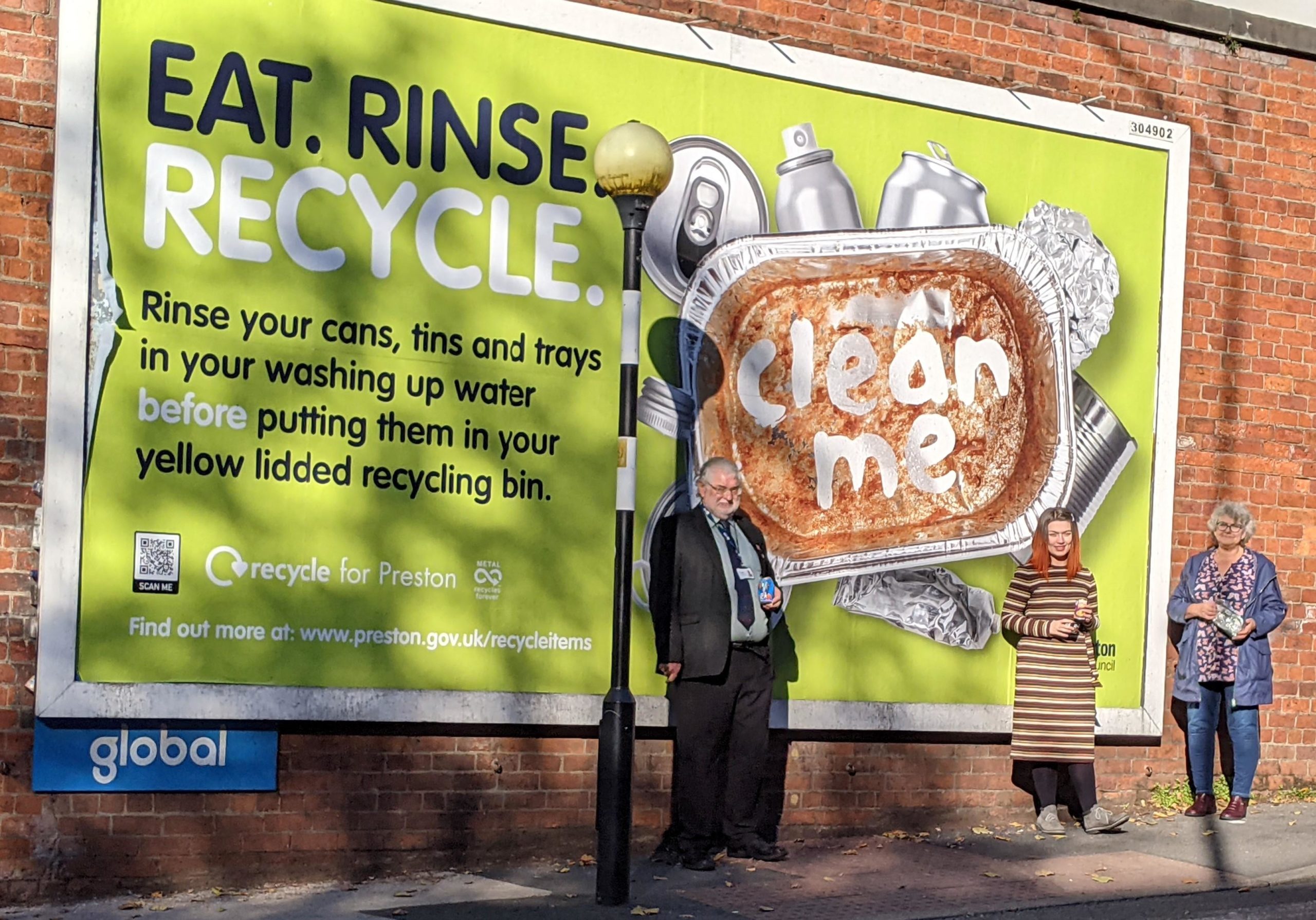
Having launched on 10 October, the programme is set to run for six weeks, aiming to increase the amount of metal packaging recycled by households across the city.
Councillor Carol Henshaw, cabinet member for climate change at Preston City Council, said: “Working in partnership with Alupro to deliver this new campaign will allow us to engage with thousands of residents.
“While most households in Preston already recycle a high percentage of used aluminium, we want them to go one step further and rinse these materials to minimise the risk of contamination. It’s a simple job, but one that really benefits the environment!”
Recycling food waste important for businesses
Research found that almost half (46%) of surveyed businesses across the UK have food waste “at the top of their priorities” to reduce their carbon footprint.
The study, which looked at 200 businesses across the UK, was carried out by an organics recycling company Keenan Recycling.
The results showed that 19% of the responding companies are more concerned about recycling food waste, than they are plastic and cardboard.
For 16% of respondents, the transition to electric vehicles is important, with 10% decreasing use of paper and print materials.
‘Reducing food waste’ was cited as the third biggest priority for business, with 33% of respondents wanting to stamp down.
Grant Keenan, managing director at Keenan Recycling, said: “Since 2016, any business that operates in Scotland and produces more than 5kg of food waste has a legal obligation to recycle by a registered waste carrier service, this is still not the case in England, but it’s heartening to see that businesses now see it as their top focus irrespective of legislation.”
Council launches paint reuse service
West Berkshire council announced that it has launched a community paint reuse service at its household waste recycling centres (HWRCs) at Newbury and Padworth.
The move comes as part of Recycle Week 2022, the theme of which is ‘Let’s Get Real about Recycling’ this year.
The project, titled Community Repaint, will see residents able to drop off left over paint at HWRCs in the usual way. Staff will then see if it is in a good enough condition to be reused.

Residents can then visit the paint reuse section and browse. If they aren’t happy with the quality of the paint, it can be taken back to the HWRC.
Visitors to the site must ensure they have registered for a digital permit and booked an appointment.
Councillor Steve Ardagh-Walter, executive member for environment and transformation at West Berkshire council, said that the council recently installed two mini-recycling centres at Theale and East Garston. Additionally, a separate food waste collection service is sent to start from the end of this month.
ZWE says EfW doesn’t reduce reliance on Russian gas
Incineration is “too inconsequential” to reduce the European Union’s dependence on Russian gas, according to a study published today (20 October) by Zero Waste Europe.
The report, titled ‘Incineration: What’s the Effect on Gas Consumption?’, was conducted by Equanimator. It found that energy from waste (EfW) displaces just over 1% of the EU’s consumption of fossil gas.
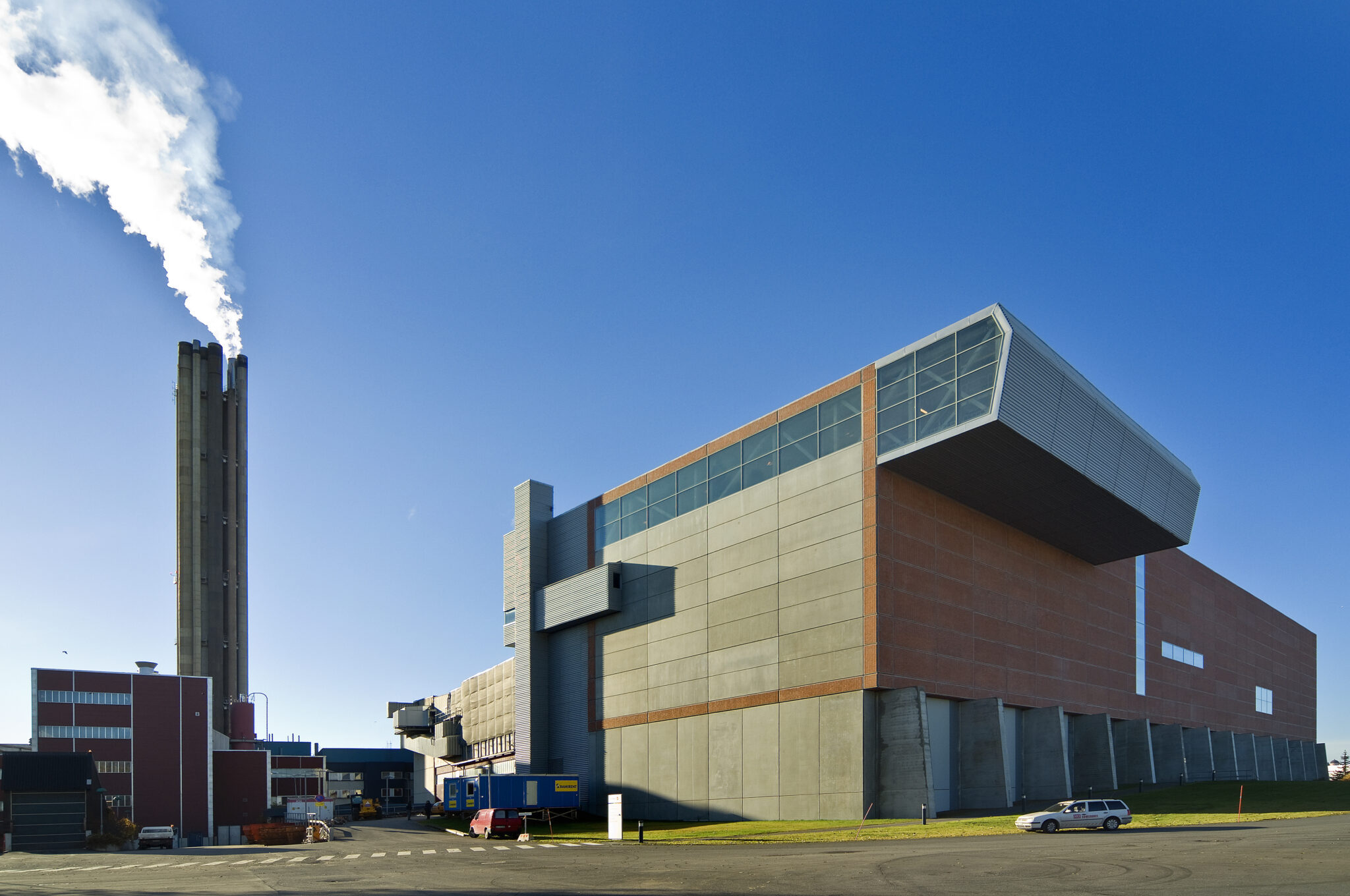
Consequently, the report “disproves the waste industry’s claims that incineration could help reduce the EU’s dependency on Russian gas,” its authors said.
The study found that even if all EfW is used to displace gas, it would only displace about 3.7% of the EU’s consumption of gas. It added that the requirement for new facilities is limited.
If new facilities were to be build, it’s unlikely they would have an impact on gas use in the short term due to the time they take to build, the report continued.
Therefore, ZWE calls upon authorities to prioritise investments that help to decarbonise energy and waste, instead of expanding facilities which are already the most carbon intensive energy sources in some countries.

Register for free to comment