




The Waste and Resources Action Programme teamed up with the British Standards Institute to produce two Publicly Available Specifications – PAS 107 and PAS 108 – which are hoped to increase customer confidence in recycled rubber products made from used tyres.
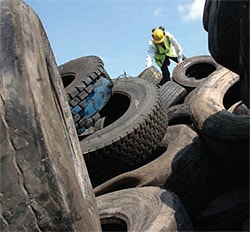 Some 46 million used tyres a year must now be recycled or recovered each year in the UK |
Drawing together various different specifications across the UK, the voluntary standards set out benchmarks of quality in an industry which has historically lacked guidelines.
The specifications are expected to help tackle the 46 million used tyres which are scrapped in the UK each year.
Under the Landfill Directive, the UK banned all whole and shredded tyres from going to landfill from last July (see letsrecycle.com story).
Jacks Guinness, marketing project manager for Tyres at WRAP, said: “PAS 107 refers to the manufacture and storage of size-reduced tyre derived rubber materials and PAS 108 refers to the production of tyre bales for use in construction.”
She added: “The documents outline the key uses for end of life tyres which, with over 100,000 tyres being taken off cars, vans and trucks every day, are in plentiful supply.”
PAS 107
Under the new WRAP standards, PAS 107 governs the source, storage and production of tyre shred or crumb created through cutting or grinding at or above room temperature. This material can be uses as an aggregate replacement in roads, for play surfaces and parkways.
The standard mentions emerging new technologies for tyre recycling such as cryogenic treatment and water jetting but excludes commercially unproven technologies such as pyrolysis.
PAS 108
PAS 108 meanwhile outlines the density, porosity and dimensions of tyre bales for use in road foundations, embankment fill and drainage systems. This can be adopted by suppliers so that potential customers will be assured they are procuring a material of consistent quality.
| Related links: |
Both standards follow a detailed consultation by WRAP with the tyre industry.
Ms Guinness explained: “We worked closely with a wide range of experts from the industry to ensure that the standards being met were measurable, realistic, specific and gave the highest quality reachable.”

Subscribe for free