



WRAP – the Waste and Resources Action Programme – said today its nationwide trials are, from this month, to include collections from retail take-back, community drop-off points and postal collection schemes.
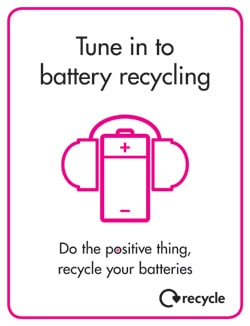 Posters being used to publicise WRAP's national battery recycling trials |
The government-funded organisation is working with local authorities, community groups, leading retailers and the Royal Mail to run the trials over the next 18 months.
Retailers taking part include Argos, B&Q;, Currys, Currys.digital, Homebase, PC World and Tesco.
Trials
The trials will take place at 33 selected stores in Eastleigh, Hampshire; Swansea, Wales; and Perth & Kinross at a later date. Customers will be encouraged to bring their unwanted batteries with them when they visit the stores and deposit them in the special battery collection containers located in the stores.
Community drop-off battery recycling schemes will be tested in the London borough of Camden and in Cherwell, Oxfordshire.
Rural homes are also being included in the expanded trials – through a postal collection scheme. This is being tested by Cumbria county council, Eden district council and Dumfries & Galloway council.
Portable
The battery recycling trials include all non-lead household portable batteries, but do not include car batteries or industrial batteries. All collected batteries will be recycled by West Midlands firm G&P; Batteries.
The expanded battery recycling programme follows the launch of kerbside collection services for over 350,000 households across the UK earlier this year (see letsrecycle.com story).
WRAP said the expanded trials will allow an extra 400,000 homes to recycle their used batteries.
Chris Davey, local authority relations manager for WRAP, said: “These new trials complete the initial phase of our battery recycling work. I am delighted that so many partner organisations are working with WRAP to find out how we can best collect batteries for recycling in the UK.”
“We hope to deliver a cost effective, long-term solution that will help us encourage behavioural change and turn the tide on the 600 million batteries currently being sent to landfill each year.”
Directive
Europe published its Battery Directive late last month (see letsrecycle.com story), a measure that will require battery producers and retailers to pay for the collection and recycling of spent batteries.
The UK has two years to bring the Directive into domestic law, with the first EU battery collection targets to be reached by 2012. The UK produces around 22,000 tonnes of non-lead batteries, with collection rates believed to be little more than 1%.
| Related links: |
A collection rate of 25% must be achieved by 2012 if the UK is to comply with the EU Directive.
WRAP said results from the different trials will help the government to identify how batteries should be collected when it develops new regulations to bring the Battery Directive into force.

Subscribe for free