



It’s been a rocky start to the year, to say the least. From the temporary closure of the markets to accreditation delays, trading Packaging Recycling Notes (PRNs) has not been an easy business so far in 2026. On top of that we can add recycling target increases, major changes in export regulations and the impact of war in the Middle East into the mix. Oh, and all of this is happening at a time when recycling plants are closing across the UK – and beyond.
So, how have the markets fared?
Demand forecast
Report Packaging Data (RPD) is the new government portal for submitting packaging data, designed to replace the legacy National Packaging Waste Database (NPWD). Due to issues with the migration, accredited reprocessors and exporters were unable to issue PRNs at the start of the year.
This means that we don’t yet have any indication of in-year PRN supply.
RPD is also used by compliance schemes and direct registrants to submit placed on market data. We can use the latest data snapshot to model what UK obligation (total demand for PRNs) could look like this year, factoring in the new recycling targets.
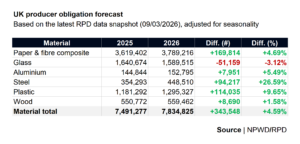
Obligations look higher for all materials except glass. The reduction in glass is likely due to the unintentional consequence of Extended Producer Responsibility (EPR): moving into lighter – though not necessarily more sustainable – materials to reduce waste management costs.
The sizeable increase in steel obligation is difficult to explain, especially given that it is generally considered a declining packaging material, but is presumably due to an anomaly in the data.
With a 9.7% increase on 2025’s obligation, plastic is expected to be a particularly tight market this year. Indeed, recent research by Ecosurety and RECOUP has shown that the UK has the operational capacity to reprocess just 23% of plastic packaging placed on market each year.
Supply uncertainty
While demand looks to be higher across most grades, there are several factors that could impact supply.
A key change relates to the rules on exporting packaging waste. Whereas previously a Packaging Export Recycling Note (PERN) could be issued at the point of export, this has now changed to the point of receipt at an accredited overseas reprocessor.
This introduces a timelag, particularly for intercontinental shipping. For example, a shipment of plastic packaging waste sent to Malaysia in November might not arrive until January, so the PERN would be issued in 2027 rather than for compliance year 2026. This will impact export-heavy materials such as paper, plastic, aluminium and steel.
Beyond regulatory impacts, the uncertain geopolitical situation in the Middle East is also affecting the markets. Oil and gas prices have soared, increasing the cost of operations, while shipping has been significantly disrupted around the Strait of Hormuz.
Overall, we are looking at a situation of increased demand and disrupted supply: the classic recipe for price increases.
While the PRN markets are not always rational – sometimes being more influenced by rumour and sentiment than the data fundamentals – there is reason to be fairly bullish at this point in the year.
A crucial period
While the RPD issues have now been resolved, and trading has resumed, we are seeing limited liquidity in the markets.
The next few weeks could be crucial.
We should get the verified 2025-Q4 data at the end of March, which will confirm the number of December PRNs that were “carried-into” compliance year 2026. Then, in early April, we will get our first look at in-year PRN generation.
Both datasets can then be compared to the obligation forecast discussed above to assess the current compliance position.
This will give us valuable insight into which materials are struggling – and will finally allow traders and PRN suppliers to have data-informed discussions around price.
If the data confirm the prevailing opinion – that supply is weak – we could see significant upward pressure on prices across key materials, especially plastic.
A difficult start to the year? Certainly.
Is there more uncertainty to come? Very likely.


Subscribe for free