



It follows a successful pilot beginning in Brynnau Primary School in Brynna, earlier this year. Around 600 people in the village eventually took part in the trial, after pupils convinced them to do do, and 560 signed up when the voluntary scheme was offically rolled-out.
Weekly food waste collections are also operating in Trealaw in the Rhondda and Llwydcoed in the Cynon Valley, and the council plans to introduce them to more and more communities over the coming months.
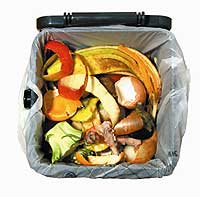
Residents who take part in the scheme, can choose one of two containers, both of which are manufactured by Straight plc. The first is a kitchen caddy with a 10-litre capacity – about the size of an ice-cream container – and the second is a 55-litre bin designed to be kept outside.
The council has said it will collect all kitchen waste including bread, vegetables, eggshells, soiled paper and cardboard food wrappings, kitchen towels, meat, teabags and coffee grounds, as well as bones.
Council officers collect the food waste seperately from recyclables and residual waste, in a Dennis Eagle refuse truck. It is reprocessed at the in-vessel composter run by Bryn Quarry Ltd in Gelligaer.
Rhondda Cynon Taf councillor Ann Crimmings said: “This is another `Rolls Royce' scheme adopted by Rhondda Cynon Taf Council and I'm pleased to see that once again we are at the very forefront of recycling initiatives throughout Wales.
“Other local authorities will realise that our pioneering approach to recycling will be accepted as a benchmark for others to follow.
“We hope that even more of our residents take advantage of yet another new recycling scheme and help us in securing a better environment for the next generation to enjoy.”
Kerbside
As well as food waste, Rhondda Cynon Taf council collects paper and cardboard, cans, foil, glass, garden waste, plastic bottles and Tetrapak cartons from the kerbside. Recyclables and residual waste are both collected weekly.
Cllr Crimmings said that collecting 600 tonnes of recyclable waste in the second week of July – the highest amount ever – proved the council's “success story” in the recycling field.
She added: “Thanks to our investment and a proactive approach, we have risen from one of the worst recyclers in Wales in 2004 to one of the best in 2007. Our current figures are over 30%, which exceeds this year's new target. Before 2004, they were closer to 10%.”
The council is aiming to hit a recycling/composting rate of 40% by 2009/10.

Register for free to comment