



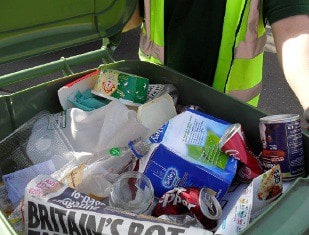
A Hertfordshire council has taken steps to avoid being challenged by the government over the quality of recyclate it produces, after switching to a commingled kerbside collection system.
Broxbourne council is among the first local authorities to switch to a commingled service since the government successfully defended its interpretation of the Waste Framework Directive in a Judicial Review brought by reprocessors, who argued that only single stream collections should be allowed (see letsrecycle.com story).
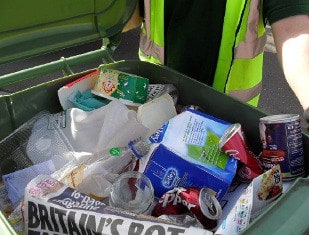
Justice Hickinbottom ruled in March that councils were free to employ commingled collections of paper, card, metals and glass where separate collections are not technically, economically and environmentally practicable, and where it does not prevent high quality recycling.
The ruling does, however, raise the possibility that local authorities could be forced to employ separate collections of material, if commingling is found not to produce the required quality of material.
Broxbourne said it had awaited the outcome of the JR before taking the final decision to move to a commingled system, and that it has designed the new service, which will come into effect from autumn 2013, to ensure that material produced is of the highest quality.
Councillors finalised plans to switch from source separated to commingled collections of recyclables, and to reduce the frequency of residual waste collections at a cabinet meeting on June 4.
Guidance
‘The council is aware of the possible issues surrounding mixed recycling and waited for the outcome of the recent Judicial Review into commingled recycling before making a decision on moving to this type of service.’
Broxbourne borough council
The government is seeking to develop guidance for councils over their requirements under the Waste Framework Directive. Resource minister Lord de Mauley told delegates at the conference of the Chartered Instituiton of Wastes Management (CIWM) conference last week that Defra hoped to minimise the risk of councils being challenged over commingled collections (see letsrecycle.com story).
A spokesman for Broxbourne said: The council is aware of the possible issues surrounding mixed recycling and waited for the outcome of the recent Judicial Review into commingled recycling before making a decision on moving to this type of service.
The council, as part of the Hertfordshire Waste Partnership, is in the process of securing a contract for the reprocessing of commingled material and quality is at the heart of this. The winning contractor will have to demonstrate that they are able to produce material of sufficient quality so that it can be turned into new material. The council is also aware of the consultation currently taking place on the materials recycling facilities (MRF) code of practice and the winning contractor will need to meet these requirements.
Furthermore, the type of materials collected has also been considered to ensure that the final product is of a good quality. Although glass will be collected, items such as soft plastics (plastic bags and film) will be excluded to make it easier for the MRF to sort.
Changes
The council hopes to improve its recycling rate, which is currently among the lowest of the ten Hertfordshire districts, by making a wider range of materials available for collection, and by making the system simpler for residents.
Under the changes, householders will be receiving a 240 litre wheeled bin, which will replace the two 55-litre boxes that residents currently have for plastics, cans, paper and glass. Residual waste is collected in purple sacks.
The council, which has an in-house collection service, has also added more materials, including aerosols, foil and cartons to the list of items that can be collected, and has asked residents to transfer cardboard from their green and food waste bin, as it is currently collected, into the commingled dry waste bin.
Related Links
Commenting on the service changes a council spokesperson said: Broxbourne has one of the lowest recycling rates in Hertfordshire which is not good for the environment and costs taxpayers a lot of money. The new scheme is designed to increase recycling rates by making it easier for residents to recycle and to enable them to recycle a wider range of items.


Subscribe for free