

Aberdeenshire-based Russel Goodenough, 48, was jailed last week for 18 months after setting up scrap metal firm ‘T’ir Trading’ in 2010 and importing tonnes of scrap metal from Europe which he sold on in the UK. He then charged customers a total of £205,600 in VAT and failed to pass this on to HMRC.

Mr Goodenough pleaded guilty at Aberdeen Sheriff Court to being knowingly concerned in the fraudulent evasion of VAT.
Speaking about the conviction, Cheryl Burr from the HMRC investigation service said: “Goodenough deliberately lied about his trade with European countries to throw us off the scent of his premeditated VAT evasion, but now he is paying the price behind bars.
“The VAT he charged should have been used to fund the public services used by us all, but Goodenough decided to pocket the lot.”
Wider issue
A spokesperson for the BMRA said that while the association is pleased to see a conviction, it is “urging” government to tackle VAT fraud by introducing ‘reverse charge VAT’.
Apart from Malta, the UK is the only country in Europe not to have introduced reverse charge VAT on scrap metal, which moves the responsibility for the recording of a VAT transaction from the seller to the buyer.
The spokesperson commented: “This makes us an easy target for criminal gangs looking to profit from carousel fraud. For example, with its high value – copper whether the actual metal exists or is only moved across boundaries on paper – is particularly attractive to fraudsters. The BMRA is urging government to tackle VAT fraud, whether it is simple VAT fraud or carousel fraud by introducing reverse charge VAT. This measure would quickly disincentivise both types of fraud.”
Reform
The conviction comes in the midst of a crackdown across the EU on carousel fraud, which the European Commission last year said can cost over €50 billion a year “in the most cautious estimates”. EU states recently identified cross-border VAT fraud as one of their top ten priorities when it comes to the fight against organised and serious international crime.
Europol provides support to joint investigation teams across member states through a scheme called Eurojust. This has led to dozens of arrests across the continent.
VAT rules in the EU state that cross-border transactions between EU Member States are zero-rated for VAT purposes. Carousel fraud is when someone imports a product from the EU before selling it in the UK and charging VAT, but pocketing the money instead.
CAROUSEL FRAUD
Europol, the European Union’s law enforcement agency, explains that Missing Trader Intra-Community Fraud is costing revenue authorities around 60 billion Euros annually in tax losses, missing trader intra-community (MTIC) fraud is the theft of value-added tax (VAT) from a government by organised crime groups.
It notes: “The basic MTIC fraud model involves organised, sophisticated activities that seek to exploit differences in how VAT is treated in different EU Member States. The criminals create a structure of linked companies and individuals across these states in order to abuse both national and international trading and revenue-accounting procedures.
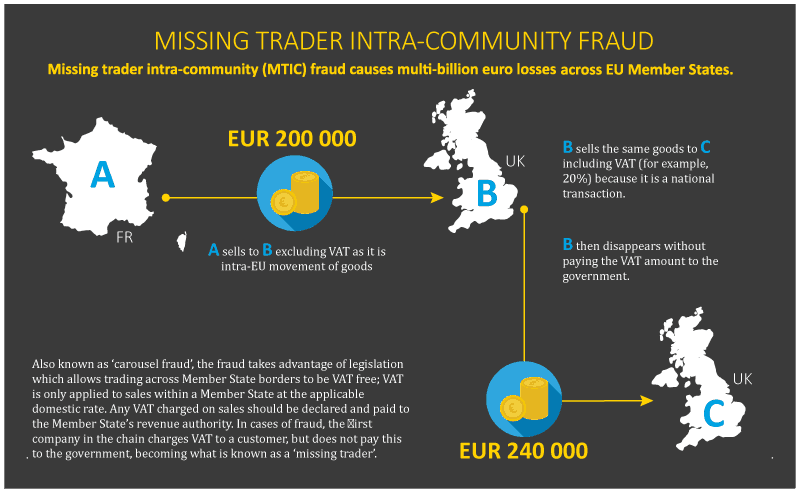
“Also known as carousel fraud, this crime takes advantage of legislation that allows trading across Member State borders to be VAT free: VAT is applied only to sales within a Member State at the applicable domestic rate. Any VAT charged on sales should be declared and paid to the Member State’s revenue authority. In MTIC fraud, the first company in the domestic chain charges VAT to a customer, but does not pay this to the government, becoming what is known as a “missing trader”.
“Links between participants are disguised to make early detection more difficult. The initial entities responsible for the tax damage, the missing traders, may operate for only a few months before disappearing.”
A Europol diagram of Carousel Fraud is shown below: