


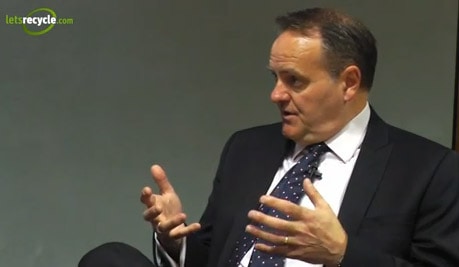
In an exclusive video interview with letsrecycle.com, Ian Wakelin said that the High Wycombe-based business had been performing “very well” since a debt restructure in 2013 which allowed it to significantly write down its debt.
He commented: “The business has performed very well, we’ve see revenues grow year on year and profits improve 30% with an EBITDA [Earnings Before Interest, Tax, Depreciation and Amortization] to over £100 million this year.”
On the issue of acquisitions, Mr Wakelin pointed to eight takeovers made by Biffa in the last 18 months – including the commercial waste collection arms of Shanks and PHS Group – and said this was something he would like to now see continue.
“We’d love to continue doing that, and I do think this industry will continue going through a period of consolidation,” he said. “There are still too many players in my opinion in the waste market.”
Expansion overseas is also something Biffa is considering, despite the company focusing solely on the UK until now, Mr Wakelin confirmed. South and Central America are areas of particular interest.
“There is a definite opportunity for us to take that expertise and technology to markets that are going through the same environmental journey that Europe and the UK have been through over the last decade”, he explained.
[testimonial id = “219” align=”right”]
Looking to the future, Mr Wakelin confirmed that a stock market flotation was a possibility as Biffa’s current hedge fund owners – Angelo Gordon & Co, Avenue Capital Group, Babson Capital Europe Limited and Sankaty Advisors (see letsrecycle.com story) – did not operate on a long-term ownership model.
“I think it is undoubtable that the business will change hands at some time in the future”, he said. “A stock exchange listing would be a very credible route for the business to go.”
RDF
During the interview, Mr Wakelin also discussed refuse derived fuel (RDF) – a market which he described as “fascinating”.
At present, Biffa exports around 500,000 tonnes of the 1.5 million tonnes of residual waste it collects to the European Continent to be burnt in energy recovery facilities and last month signed a deal to send some to a gasification plant being developed in the UK, in Hertfordshire.
When asked if RDF would increasingly be treated in the UK, Mr Wakelin said it would “provided the UK can be competitive on disposal price.”
However, he warned against keeping it in the UK “just because it feels like the right thing to do”.
He commented: “We are an industry that is operating in a global market. We ship recycling all around the world and we will do indefinitely. Why not ship RDF if the economic and environmental impacts of that makes sense?”
Risk
Discussing the broader market conditions in the UK at present, Mr Wakelin spoke of the volatility in the commodities markets and said that he believed, for too long the risk of large price fluctuations had rested with the waste management industry rather than the producers of waste, such as councils and businesses.
“There has to be an acceptance from those producers that recyclate prices will vary and the risk has to go back to the producers”, he commented.
With the General Election just a few weeks away, Mr Wakelin finally spoke of his hopes for the next government, claiming that consistency in policy on issues such as landfill tax and energy-from-waste subsidies was a main priority.
For the full interview please click on the video above.

Subscribe for free