


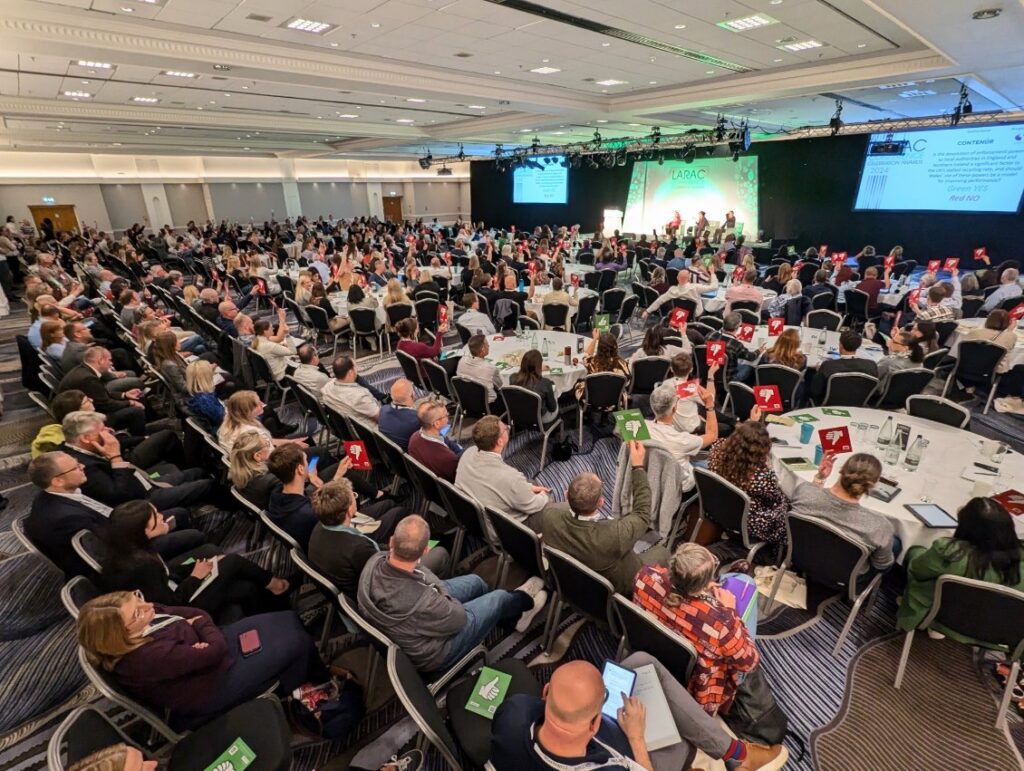
Bates informed the audience that local authorities will receive their indicative payments in next month – November 2024.
Day one of the two-day conference will be followed by an awards ceremony tonight.
Yesterday (8 October 2024), LARAC celebrated 20 years of its scholar programme.
Update on Defra policy progress
Bates gave an overview of the current state of three pieces of Defra legislation: pEPR, Simpler Recycling and the Circular Economy Strategy.
She highlighted that the pEPR steering group will be meeting in the near future to discuss producer responsibility organisations (PROs) and co-design.
Alongside when local authorities can expect indicative fees to be released, she confirmed that the finalised fees will be released to businesses after April 2025.
In terms of Simpler Recycling, Bates said the government is still committed to meeting the timeline proposed by the previous government in October 2023.
In June this year, the Labour manifesto promised to create a Circular Economy Strategy to move the UK towards a zero waste economy. Bates confirmed that this will apply only to England and will include targets for waste reduction. She highlighted several barriers the government needs to overcome, including the lack of data availability. A report by the Copper Sustainability Partnership (CuSP) showed that the Conservatives phased out over half of waste and recycling datasets since coming to power in 2010.
Learning from Welsh recycling
In the second keynote address, Andy Rees OBE, head of waste strategy for the Welsh government, ran through the successes and lessons from the implementation of the Welsh Collection Blueprint which was published in 2011 and reaffirmed in 2016.
Analysis from WRAP has shown that Wales currently has the second-best recycling rate in the world, after only Austria.
Rees emphasised that the data analysis coming out of Wales shows that fewer residual waste collections lead to better recycling rates. Two local authorities in Wales are even running residual waste collections only once every four weeks.
Notably, 100% of local authorities in Wales currently offer separate weekly food waste collections – covering 99% of all households. After authorities reduced residual waste collections to once every three weeks, the average volume of collected food waste went up 20%. Alongside this, kerbside dry collections went up 10% and kerbside residual saw a 19% reduction. Rees encouraged the audience: “Restricting residual works”.
Additionally, Rees identified that, opposed to common misconceptions, some of the most deprived areas in Wales have the highest recycling rates.
He concluded by stating that Wales is aiming for a 100% recycling rate by 2050.
Session two: CPR in action
Session two focused on the government’s incoming Collection and Packaging Reforms (CPR).
Julia Bragg, WRAP’s specialist on waste and recycling discussed the non-statutory guidance for local authorities.
She said that WRAP and Defra have been working with manufacturers to produce guidelines to assist with the imminent volume of procurement requests. This includes standardised specifications for containers and vehicles, supplementary procurement guidance and a procurement pipeline database.
Bragg was followed by Vicky Horsfield, YPO’s category manager for facilities and waste management, who discussed the assistance YPO can offer in meeting new food waste regulations. Under Simpler Recycling, local authorities are mandated to provide food waste collections to most households by 2026.
Ahead of a Q&A session, Tim Walker, chief executive at arc21, gave advice on disposal methods and the place of disposal in a zero waste world. He warned that we are heading towards a failure in the current system of disposal as we approach the transition.
Session three: Other materials
The third session of the day featured a focus on the challenges local authorities face in dealing with Waste Electrical and Electronic Equipment (WEEE) and textiles waste streams.
Niamh McBride from Material Focus laid out the complex situation in the WEEE industry – particularly the challenges presented by vapes, “FastTech” and e-scooters.
She called on local authorities to make use of Material Focus’ Electricals Recycling Fund which is available to assist local authorities in the collection of small electronics.
The charity also has a wide range of assets to support local authorities in communicating with their audiences – she encouraged the audience to reach out if they had any further ideas.
She finished by drawing attention to the annual International E-Waste Day, sponsored by REPIC, which will take place next week (14 October 2024). Material Focus has launched “The Great Cable Challenge” under the banner of Recycle Your Electricals to encourage the public to recycle old cables rather than throw them in the bin or abandon them in the drawers.
Next, Clare Harby from Ward and the Textiles Recycling Association laid out the nuances of the textiles industry and the looming crisis facing reused textiles collections and processing.
Harby said she was shocked to learn that there has been a 400% increase in the consumption of clothing in the two decades. Current consumption levels are expected to increase by a further 63% by 2030. The textiles industry currently produces more carbon emissions than both the shipping and aviation industries combined.
However, Harby said that Household Waste Recycling Centres (HWRCs) are currently finding their profits are dropping when it comes to textiles recycling. This was due to a series of factors – including an influx of low-quality fast fashion textiles and the Ukraine crisis. Ukraine has historically been a significant market for used textiles.
She suggested the industry shift focus to the reuse of textile rather than recycling – as the latter is expensive with very few recyclers being located in the UK.
She also said that more needs to be done to inform customers about the details of textiles recycling – for example that blended fabrics cannot be recycled.
Finally, she issued a strong message of support for a government-backed textiles EPR.
Session four: Behaviour change: What works in practice
In the interactive fourth session, Livvy Drake from Sustainable Sidekicks walked the audience through the process of creating a behaviour change campaign with examples illustrated by Stephanie Campbell from Hubbub.
Steps such as segmenting the audience, acknowledging gaps in skills and knowledge, overcoming mental shortcuts and convincing the consumer of the cost/benefit analysis were all highlighted.
Campbell demonstrated examples of behaviour change campaigns such as bright and colourful coffee-cup shaped bins to encourage the recycling of disposable coffee cups.

Subscribe for free