



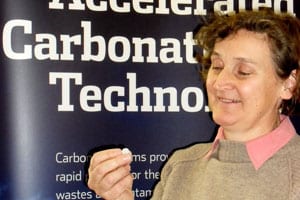
The plant, which is one of the UK’s first air pollution control residues recycling facilities, will use Accelerated Carbonation Technology to treat the residues and produce an output which meets end-of-waste criteria laid out by the Environment Agency, meaning it can be used for aggregates.
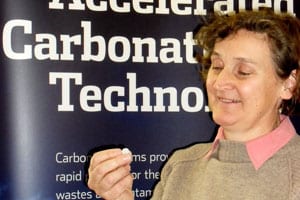
Grundon Waste Management has become a significant shareholder in Carbon8, the company that designed the patented technology for the Brandon, Suffolk facility which is expected to open in February 2012.
The 1 million plant has a permit to process up to 18,000 tonnes-a-year of the residues, generating an output of around 36,000 tonnes of recycled aggregate for use in the block works industry.
Commenting on the benefits of the technology Richard Skehens, managing director of Grundon, said: Although the volumes of hazardous waste in the UK are generally declining in volume, the increase in energy from waste facilities will generate a corresponding increase in the volumes of air pollution control residues. Ever tightening environmental regulations and standards for hazardous waste disposal mean that tailor made new technologies offer significant opportunities in this market place.
Grundon already operates a APCr plant at its Wingmoor Farm landfill site, Gloucestershire, which mixes APCr with water before it is transferred to a hazardous waste cell in the landfill.
‘Air pollution control residues are very fine powders, like talcum powder, generated from Energy-from-Waste plants’ — Grundon
Process
The plant will use Accelerated Carbon Technology, a controlled version of the naturally occurring process of carbonation, to treat the residues.
Carbon dioxide will be added to moist air pollution control residues producing an exothermic reaction and precipitation of calcium carbonate, the key component of chalk and limestone. The carbonate precipitates stabilises the contaminated materials. Once this process is complete it is then added to other binders and fillers to produce an aggregate.
The process uses waste carbon dioxide, which in the case of the Brandon plant is generated from a nearby sugar beet processor, which then allows for its permanent capture.
Next step
Commenting on the process Dr Paula Carey, who helped develop the technology, said: After many years of research it is fantastic to see all our hard work come to fruition. Permanent capture of carbon dioxide using an innovative UK technology is even more compelling when it can be used to provide a sustainable waste management solution. The work does not stop here however, as the next phase is to capture carbon dioxide from the flue stack source to produce an even lighter aggregate.
Carbon8 managing director, Mark Osbourn, believes the next step is to develop a national network of facilities. He said: We have clearly demonstrated that air pollution control residues can be recycled, changing the landscape within the waste hierarchy. Our strategy moving forward is to provide a national network of such facilities.

Subscribe for free