


The North East waste business was contracted to supply the two 350,000 tonne-per-year plants with refuse-derived fuel.
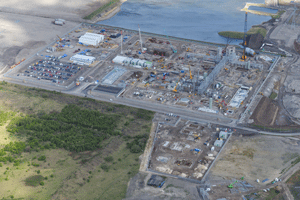
Feedstock for the project would have been provided by Impetus’ own 10-year residual waste treatment contract with City of Hull council, signed in 2014.
In order to meet the huge requirements of the Air Products contract, Impetus had developed a 500,000 tonne-per-year waste transfer station. According to the waste company, it is the “the largest commercial transfer station in Europe”.
However, Impetus has now confirmed that it took the “difficult decision” to revise its strategy last year and reorientate operations away from Air Products.
Outtakers
Since 2015, the waste firm has been sending RDF produced at the transfer station to ‘alternative RDF outtakers’ in continental Europe in anticipation of Air Products’ decision to exit Tees Valley.
Impetus notes that this “challenging transition” has now fully replaced the anticipated Air Products RDF volumes and it has “emerged stronger from this process”.
Cameron Savage, chairman of Impetus, said: “We are sorry to see Air Products exit these projects, which have had such a positive impact on jobs and the local community.
“However, the steps we have been able to take in recent months mean that we are no longer exposed to Air Products and are well positioned to grow our business. We therefore expect no negative impact on jobs or revenues at Impetus. We wish Air Products the best of luck with the potential sale.”
These new RDF agreements are coupled with the recently announced consolidation of the company’s waste processing facilities at its North Tees facility in Port Clarence.
GMB
Responding to Air Products’ announcement, the GMB trade union has branded the decision “incompetent”.
Air Products yesterday confirmed that there were some 125 employees at the Tees Valley 1 site as well as 20 contract workers.
Michael Blench, GMB Regional Officer, said: “This is another crushing blow for employment on Teesside.
“Both Tees Valley energy from waste projects, TV1 and TV2, have provided employment for the region but the inability of Air Products to purchase the right, proven technology and then its reported incompetence at rectifying the design flaws has now resulted in both plants being potentially scrapped. “

Subscribe for free