


Speaking at the Communications Conference 2026, Defra’s Howard Davies stressed that while the policy intent behind Simpler Recycling is “sound”, pressure now lies firmly on delivery.
Local authorities, he noted, are operating within a “complicated world” shaped by legacy contracts, political scrutiny and residents who already feel “bombarded with change”.
Yet readiness is uneven. Recent reporting from the BBC has suggested that more than 70 councils may not be fully prepared to introduce consistent food waste collections by the deadline.
That complexity means communications strategies cannot be standardised. Every authority is starting from a different baseline in terms of infrastructure, service design and public understanding. While national consistency in messaging remains essential, local execution must reflect local demographics and behaviours.
What is clear is that communications cannot be a “one size fits all” approach. Instead, authorities are increasingly adopting targeted, evidence-led approaches that combine national messaging with local nuance – using a mix of old and new channels to reach residents where they already are.
Face-to-face communication: Lincolnshire
One of the clearest emerging lessons ahead of Simpler Recycling is that face-to-face communication remains essential when asking residents to change everyday habits. Direct, local engagement provides opportunities for residents to ask questions, builds trust and helps translate policy change into practical action at household level.
Ahead of Simpler Recycling rollout, the Lincolnshire Waste Partnership has been coordinating a consistent approach to service changes across the county, even though implementation is being phased at different times.
Recognising that not all residents are online, the partnership has invested in offline communication channels. Printed “Right thing, right bin” leaflets, the County News newsletter delivered to every household several times a year and local radio advertising all form part of the campaign.
Community touchpoints are central. Engagement takes place through council meetings, coffee mornings and other local events, allowing residents to discuss changes directly with officers.
Schools outreach has become another cornerstone of the strategy, reflecting the growing recognition that children can act as effective messengers within households. Lincolnshire County Council’s first Environment Day brought together more than 250 pupils from ten primary schools for hands-on recycling and environmental activities, including a recycling-themed Olympics designed to build understanding through practical experience.
Together, these approaches have allowed the Lincolnshire local councils to reinforce a broad communications campaign that reaches diverse communities with different bin systems, where digital channels alone are unlikely to reach everyone.
The council has blended traditional engagement with digital reinforcement, including an animated video series designed to mirror offline messaging and provide clear, accessible guidance online.
Low-cost intervention: South Ayrshire
That said, physical visibility does not always need to come from labour-intensive engagement such as door-knocking or attending community events.
A Zero Waste Scotland trial with South Ayrshire Council examined the impact of three measures: adding “No Food Waste” stickers to residual bins, providing free caddy liners and delivering a package of communications activity.
All three interventions increased participation and the amount of food waste collected, with the stickers produced the most significant results: increasing participation by 7.7% and food waste yield by 42% at relatively low cost.
Analysis of resident responses suggested that the most effective approach is often a tailored combination of interventions, matched to local performance levels and circumstances.
The findings reinforced a wider evidence base indicating that layered interventions –combining motivation, information and practical support – are more effective than communications alone.
For councils preparing for Simpler Recycling, the message is that small, well-targeted nudges can sometimes deliver outsized gains.
Tackling disengagement: Newcastle-under-Lyme
If Lincolnshire and South Ayrshire illustrate the value of broad engagement and practical interventions, Newcastle-under-Lyme highlights the importance of targeted communication in areas with lower participation.
The council has operated a food waste service since 2010, but adopted a “soft relaunch” following the pandemic, supported by a dedicated recycling and waste Facebook page created in 2020. By bringing communications in-house, teams were able to design and deliver campaigns quickly using simple tools, maintaining a consistently positive tone focused on clarity and ease of use.
Where participation remains low, the council has deployed targeted postcards, letters and local civic-pride initiatives, replicating messaging across both offline and digital channels.
Transparency has proved particularly important. Partnerships with processors have enabled the council to show residents what actually happens to their food waste, helping to address misconceptions and build trust.
Behaviour change through digital creativity: Lambeth
In some areas, the challenge is not awareness but message fatigue.
Lambeth Council’s recent partnership with Hubbub and Ecosurety is testing whether more creative and disruptive communications can shift entrenched behaviour. The campaign focuses on food contamination, which accounts for nearly a third of contamination in the borough’s recycling stream.
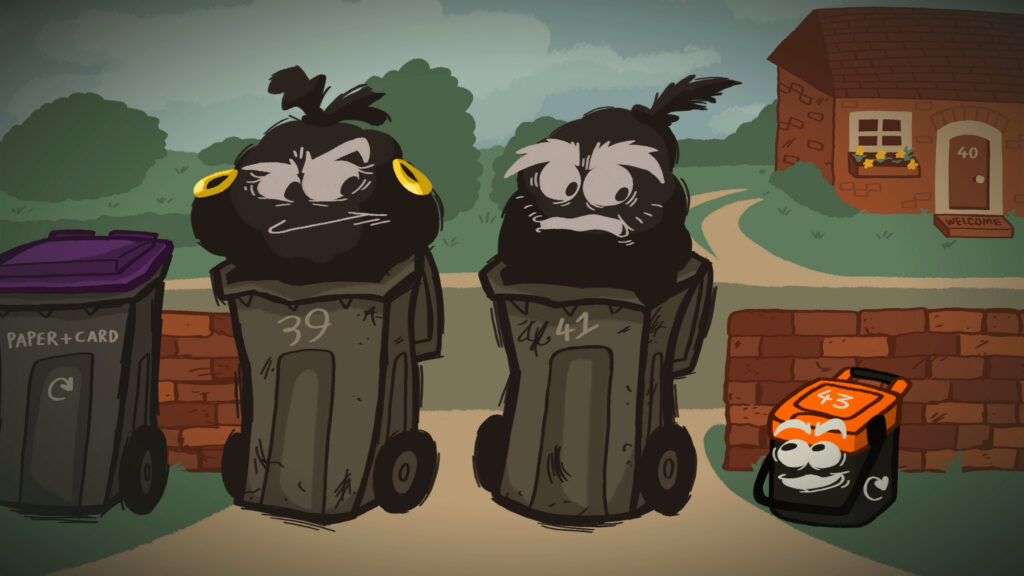
Rather than repeating standard instructional messaging, the initiative uses a deliberately playful tone designed to capture attention and encourage residents to think differently about how they recycle. The project is intended as a learning exercise, exploring whether bold, unconventional messaging can produce measurable improvements in recycling quality.
Jon Brookes, Chief Partnerships and Growth Officer at Ecosurety, commented on the project: “Building on previous success, we’re excited to fund this campaign with Hubbub to explore whether more creative, disruptive messaging can help people make small changes that have a big impact on the system as a whole.
“This campaign is about learning what really works when it comes to engaging residents and improving recycling quality.”
If successful, it could help demonstrate that behaviour change sometimes requires not just clearer information, but a different kind of storytelling altogether.
What does this mean for Simpler Recycling?
Across very different local contexts, successful approaches tend to share common features: clear audience targeting, multi-channel delivery, transparency about outcomes and a willingness to test what actually works on the ground.
At the same time, the diversity of local systems means there is unlikely to be a single model that works everywhere.
As Simpler Recycling moves from policy ambition to day-to-day reality, much of its success will be decided not in guidance documents but in kitchens, bin stores and at the kerbside.
The early experiences suggest that consistency of message will matter nationally, but credibility will ultimately be earned on the individual level.
Want deeper insight into food waste policy and innovation? Join us at the National Food Waste Conference on 19 March, London – find out more here.

Subscribe for free