


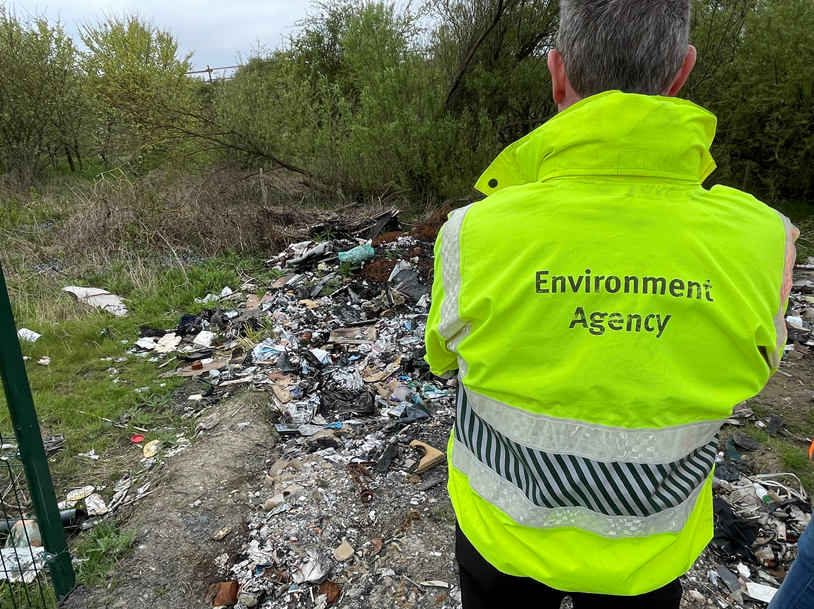
Section 109A of the Environment Act gives the EA the power to issue Restriction Orders to those who wish to enter specific premises carrying waste.
The order would prevent criminals from entering the site in an effort to prevent the accumulation of “waste mountains” which cost millions to clear.
The powers are intended to be used in cases of repeated illegal dumping and similar incidents.
In the well-known case of Hoad’s Wood in 2023, the Agency used the power following the issuance of a ministerial decree by former Environment Secretary Steve Barclay.
Most recently, the power was used in Kidlington, Oxfordshire where “hundreds of tonnes” of waste were dumped. The Agency was alerted to the crime in July 2025 and applied for a restriction order in October.
Powers not used in Wigan waste dumping
Also last year, the EA selected not to use the power in the case of the illegal dumping of 25,000 tonnes of waste in Wigan.
When asked why they did not use the enforcement power, the EA explained that it worked in partnership with the Local Authority to provide information to support the service of a Closure Order at the site.
A spokesperson for the Agency said: “Restriction Orders form part of a suite of enforcement options the EA uses when appropriate.”

A Closure Order sits under the Anti-Social Behaviour, Crime and Policing Act 2014 and applies when there is risk of anti-social behaviour.
It must be heard by a court within 48 hours and can last up to a period of three months – compared to up to six months under a Restriction Order.
Another key difference is that the Restriction Order prohibits both entry and the importation of waste, while the Closure Order only prohibits entry.
Wigan Labour MP Josh Simons was reportedly told by the EA in early 2025 that a criminal investigation was underway and that “therefore no action can be taken to prevent people from dumping more on the site or intervening”.
Samantha Riggs, defence barrister at 25 Bedford Row, disputed this reasoning: “This is incorrect. The powers under s.109A Environment Act 1995 are available in all cases and if it were to be the position that the EA could not utilise this power when there is an ongoing criminal investigation, it would make the power ineffective.”
House of Lords waste crime inquiry
The recent House of Lords waste crime inquiry described the EA’s action on waste crime as “inadequate”.
At one of the hearings, Dr Anna Willetts, defence solicitor at gunnercooke llp, raised the underuse of Restriction Orders.
Willetts said: “I informed the inquiry that I could not understand why Restriction Orders did not seem to have been used at Hoad’s Wood until it was too late, and that the powers the Environment Agency has to apply for these Orders rarely seem to be used where they ought to be.”
The cross-party Environment and Climate Change Committee who conducted the review called for the Government to urgently commission an independent review of its current approach to waste crime.

It is expected that the issue of Restriction Orders will be under the spotlight.
In a letter sent to Emma Reynolds, Secretary of State for Environment, Food and Rural Affairs, the waste crime committee warned that “waste crime is critically under-prioritised despite its significant environmental, economic and social costs”.
It urged for the review and resulting Government response to both be completed by May 2027 at the latest.
Sam Corp, Head of Regulation at the Environmental Services Association (ESA), added: “We welcome the recommendations of the committee that Government should undertake an independent review of the current regulatory approach, while taking more immediate action to overhaul the regulations; develop interim targets and bolster the resources of regulatory bodies.
“In the long term, we need to see much stronger enforcement and harsher penalties to deter criminals, and we also need to have in place a more robust permitting regime coupled with digital waste tracking to ensure waste cannot fall into the hands of criminals in the first place.”
When else has the power been used?
The EA has used its powers four times outside of Hoads Wood and Kidlington, Oxfordshire.
According to Letsrecycle records, the power was first used in May 2018 in Birmingham where a waste management company was operating without an environmental permit.
Two years later, the power was used in September 2021 after a fire at a waste site in Sunderland.
Two restriction orders were then obtained in 2023 in Sheffield and the Isle of Sheppey.
Section 109A of the Environment Act 1995
Section 109A of the Environment Act 1995 granted the EA the power to prevent repeated illegal waste dumping in order to protect the environment.
The section was inserted into The Environment Act on 29 March 2018 by The Waste Enforcement (England and Wales) Regulations 2018 and come into force 21 days later in April 2018.
The power was introduced after the EA was criticised for not doing more to protect the environment following an illegal dumping at a former Waste4Fuel site in Orpington, in the London Borough of Bromley.
It is applicable when there is a risk of “serious pollution to the environment or serious harm to human health which is a result of the treatment, keeping, deposit or disposal of waste in or on the premises”.
The Agency must make reasonable efforts to ensure that notice is given to the occupier and the owner of the premises, however – provided reasonable efforts have been made – an application for an order can nonetheless be made to the court even if it has not been possible to identify the owner or occupier.
The courts must hear the Agency’s case within 72 hours to enable the EA to act promptly and impose expedited restrictions to the site given the serious risk posed.
It may also do “anything necessary” to secure the premises against prohibited access. The Restriction Order must be prominently displayed at the entrance.
Anyone entering site in breach of the Order commits a separate criminal offence.
Restriction orders may be issued for up to six months.

Subscribe for free