


Defra has given its strongest support to date for kerbside sorting as its preferred option for household recycling collection in a consultation document published today (July 8) on draft regulations to implement the revised EU Waste Framework Directive in England and Wales.
In the document, which has been jointly published with the Welsh Assembly Government, the department confirms its position on the Directive's requirement for separate collections of materials to be introduced by 2015. This is that both kerbside sorting and commingled collection followed by sorting at a MRF count as ‘separate'.
But Defra and WAG qualify their position by stating that: “Defra/WAG support and endorse WRAP's assessment that kerbside sort should be preferred where this is practicable; and where this is not two streams commingled collections are preferable over single-stream collections.”
The documents adds that “single stream commingled collections may be appropriate in circumstances where the other options are impracticable”, further echoing conclusions drawn by WRAP in its June 2009 ‘Choosing the Right Collection System' guidance (see letsrecycle.com story). But, the consultation also stresses that the choice of system rests with individual local authorities.
The Defra position has already been seized upon by kerbside sorting advocates the Campaign for Real Recycling, whose chair, Mal Williams said: “Well done to Defra and the new coalition government for recognising that kerbside sort is more effective than MRF sort for producing high quality recyclable resources.”
Existing legislation
Defra/WAG support and endorse WRAP's assessment that kerbside sort should be preferred where this is practicable; and where this is not two streams commingled collections are preferable over single-stream collections
Defra/WAG consultation document
While Defra and WAG claim that the UK has in place the “necessary laws” to comply with the requirements of the revised Directive, they explain that the regulations being consulted on are “necessary to ensure the rWFD is fully and correctly transposed in the UK”.
As such the consultation details how existing legislation will be used to meet key provisos of the Directive such as the goal of achieving a 50% household waste recycling and composting rate by 2020 and a 70% target for construction and demolition waste by the same date, as well as the statutory need for all waste management activities to adhere to the new five step waste hierarchy enshrined in the Directive.
The document is the second stage of a two-stage consultation process on transposing the revised Waste Framework Directive into English and Welsh law. An earlier consultation paper was launched in July 2009 (see letsrecycle.com story).
Bottom ash
In light of the Directive's recycling targets, the consultation document outlines exactly what will be considered as ‘recycling' in an attempt to meet those goals, and reveals that, for the first time in England, recovering metals from incinerator bottom ash will count as recycling.
It explains: “Metals recovered from incinerator bottom ash will be classed in England as recycling as this waste can be reprocessed into a product suitable for uses similar to the original. This is a reversal of current Defra policy, but brings England into line with the approach taken in the rest of the UK.”
This decision has been made as part of the January 2010 Defra consultation on the legal definition of waste (see letsrecycle.com story) and is likely to be warmly welcomed by waste companies such as Veolia ES which just last month called for the change to take place (see letsrecycle.com story).
Metals recovered from incinerator bottom ash will be classed in England as recycling as this waste can be reprocessed into a product suitable for uses similar to the original
Defra/WAG consultation
Defra also proposes that organic material which meets the UK's end-of-waste criteria for compost and digestate will be considered recycled, “in recognition of the fact that meeting the relevant standards confers the status of a recognised product on the material”.
Hierarchy
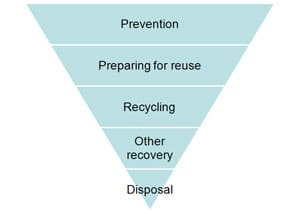
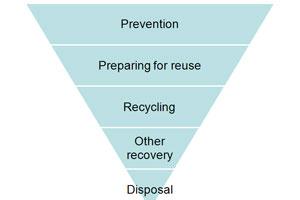
In terms of the waste hierarchy, Defra and WAG claim that the hierarchy's approach, which favours prevention as the best waste management option, ahead of preparing for reuse, recycling, other recovery and disposal, is already being used in “many areas”. But, the department explain that the hierarchy will be implemented elsewhere using a “tiered approach”.
For planning decisions, they say this should involve the updating of national planning policy statements, while also requiring councils to “have regard” to the hierarchy when preparing spatial planning documents such as waste development frameworks.
Meanwhile, for environmental permitting, it proposes that new permits or “significant variations” should involve a condition being attached that requires “permit holders to take appropriate measures to minimise the waste generated by their operation and to ensure that, where waste is generated, it is treated in accordance with the hierarchy”.
And, it includes a proposal for the duty of care waste transfer note, which must be used for all transfers of waste, to include an additional declaration where waste holders and producers have to certify their have taken the waste hierarchy into account in terms of how their waste is being dealt with.
The consultation document is accompanied by draft guidance – applicable to England only – detailing how the waste hierarchy can be applied to particular materials, and what support and choices are available to ensure that waste is dealt with according to the hierarchy.
Key points
Other key points made by Defra and WAG in the consultation include:
-
No proposals in the draft regulations for additional measures to meet the Directive's requirement for member states to encourage the separate collection of biowaste. While acknowledging that “further measures” are need here to meet the WFD's requirements, they propose these be set out in national waste policies and not the regulations;
-
A continued belief that the Directive's requirement for self-sufficiency of waste disposal should be applied at a national level;
-
There is no need to make provisions for the end-of-waste requirements of the Directive in the regulations because they have “direct effect”. This refers to work that is already going on at a European level on metals and other materials to define when they cease to be waste;
-
A decision not to introduce further measures to promote reuse or preparing for reuse
-
A decision not to introduce legislative measures on extended producer responsibility, which the Directive allows member states to do.
Energy recovery formula
The consultation provides little insight into the impact that ‘R1' energy recovery formula which the Directive says should be used to decide whether waste incinerators are a recovery or disposal option could have on UK energy-from-waste plants.
But, it does detail correspondence from the European Commission which states that not all incinerators must meet the energy efficiency requirements, only those that wish to be considered recovery, while the government states that it believes what constitutes a “high level” of energy efficiency should be different from facility to facility, and not be dealt with on a blanket basis.
The consultation is open until September 16


Register for free to comment