


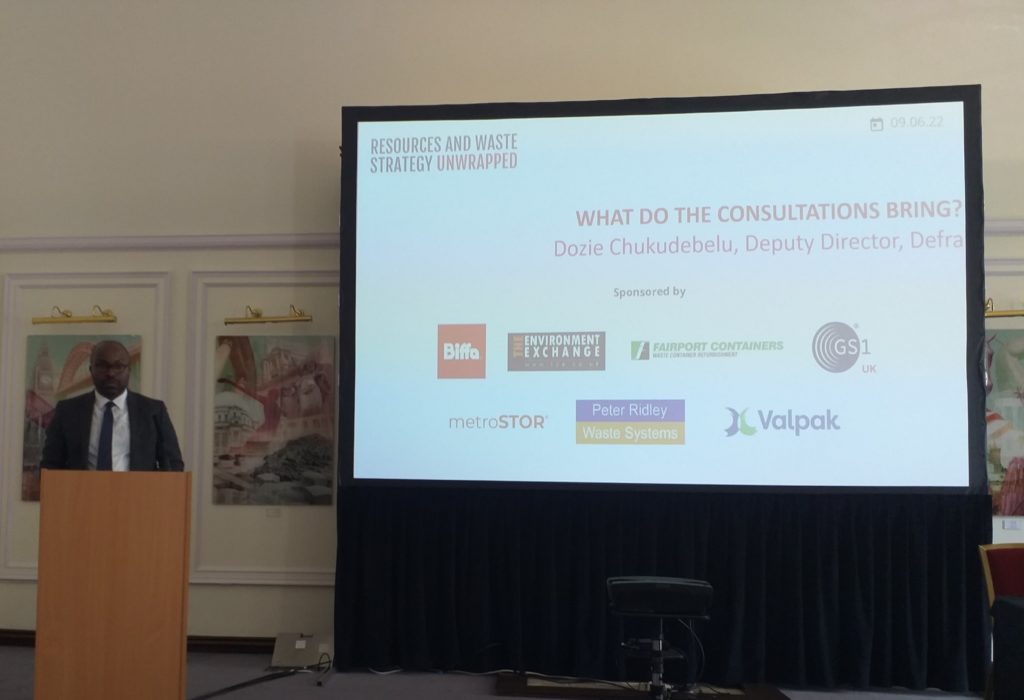
Dozie Chukudebelu, deputy director for programme delivery at Defra, was speaking at letsrecycle.com’s Resources and Waste Strategy Unwrapped conference at BMA House in London.
The consultation on consistency ran from May to July last year. Defra has yet to release its response, despite publishing similar documents on extended producer responsibility (EPR) for packaging (see letsrecycle.com story).
While he could not specify an exact date, Mr Chukudebelu said: “We are working through the final steps of the government response and I would expect that we should be in a position to publish soon.
He added: “Alongside this, we will be consulting on statutory guidance this summer. This should help local authorities and other waste collectors better understand how to apply the new legislation.”
Mr Chukudebelu also said Defra’s response to its parallel consultation on the deposit return scheme (DRS) in England, Wales and Northern Ireland was due “soon”.
Collaboration
Defra recently set up a dedicated team with experience in stakeholder engagement and operations to improve its collaboration with the waste management sector, Mr Chukudebelu said. He stressed Defra’s desire to work with industry to ensure the success of the waste and packaging sector reforms.
“Any complex system really needs close collaboration in order to effect changes and be successful,” Mr Chukudebelu said. “I do not think that Defra on its own has the understanding or the knowledge to be able to work out how those changes will happen. We need your input.”
England
Paul Vanston, chief executive of the Industry Council for Packaging and the Environment (INCPEN), also spoke at the conference, stressing the UK-wide importance of getting consistency in England’s recycling right.
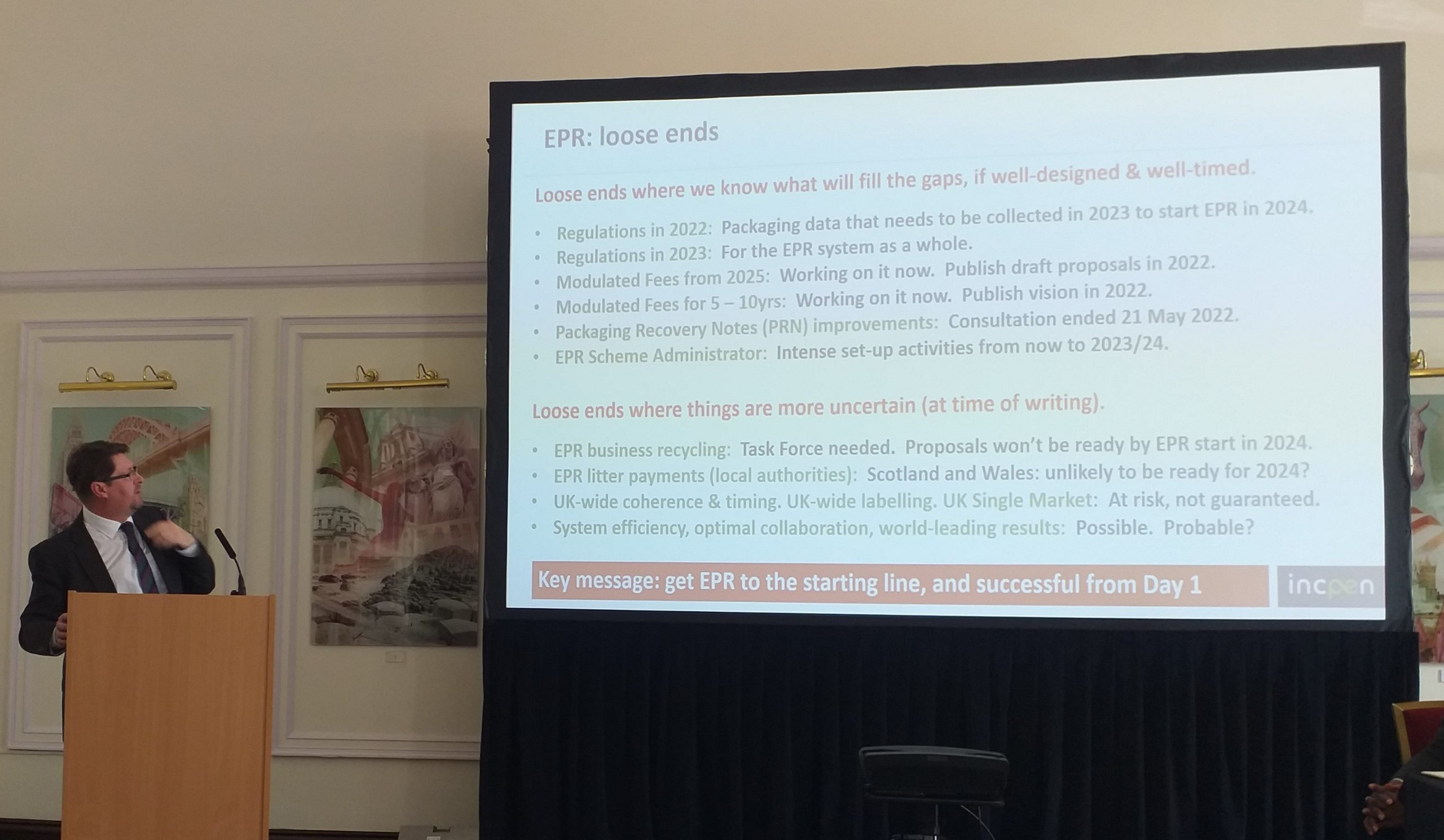
He pointed to figures from 2019 showing that England produced about 83% of the UK’s dry recycling tonnage, while the country represented 85% of the UK population and was home to the “vast majority” of the 4.6 million British businesses.
“The devolved nations are really important, but what happens in England really, really matters because of the scale of the tonnage, the population and the businesses,” Mr Vanston said.
While he noted England’s recycling rate had “plateaued” in the last decade, Mr Vanston claimed there had been improvements since the publication of the Resources and Waste Strategy at the end of 2018.
He said: “Local areas have springboarded on from 2019 in so many ways, manufacturers, retailers, brands, councils, waste management coming together in ways we’ve not seen before.
“What I want to do for the next 10 years is, wherever we are now – and it doesn’t mean being at the top of the tree – for every area of the country that makes a step forward on its performance, I want that to be celebrated.”
Scheme administrator
Meanwhile, another to speak at the conference was Deep Sagar, chair of the government’s Advisory Committee on Packaging (ACP). In a wide-ranging talk, he questioned whether there should be more than one scheme administrator for EPR.

The scheme administrator will be the public body responsible for managing and administering EPR on behalf of producers. In its consultation response, the government said the scheme administrator would be “fully operational” in 2024, but an appointment is yet to be made.
“The scheme administrator is very, very important for EPR,” Mr Sagar said. “Why not have more than one? Why not have four, one from each jurisdiction? Why create a single company monopoly because, as we all know, competition increases quality and service.”
Mr Sagar also stressed the ACP’s belief in finding a role for producer compliance schemes within the EPR framework.
Businesses
And, Chris Mills, special adviser at resources charity WRAP, spoke at the conference as well. He suggested the reforms under the Resources and Waste Strategy were to unfold in three phases.
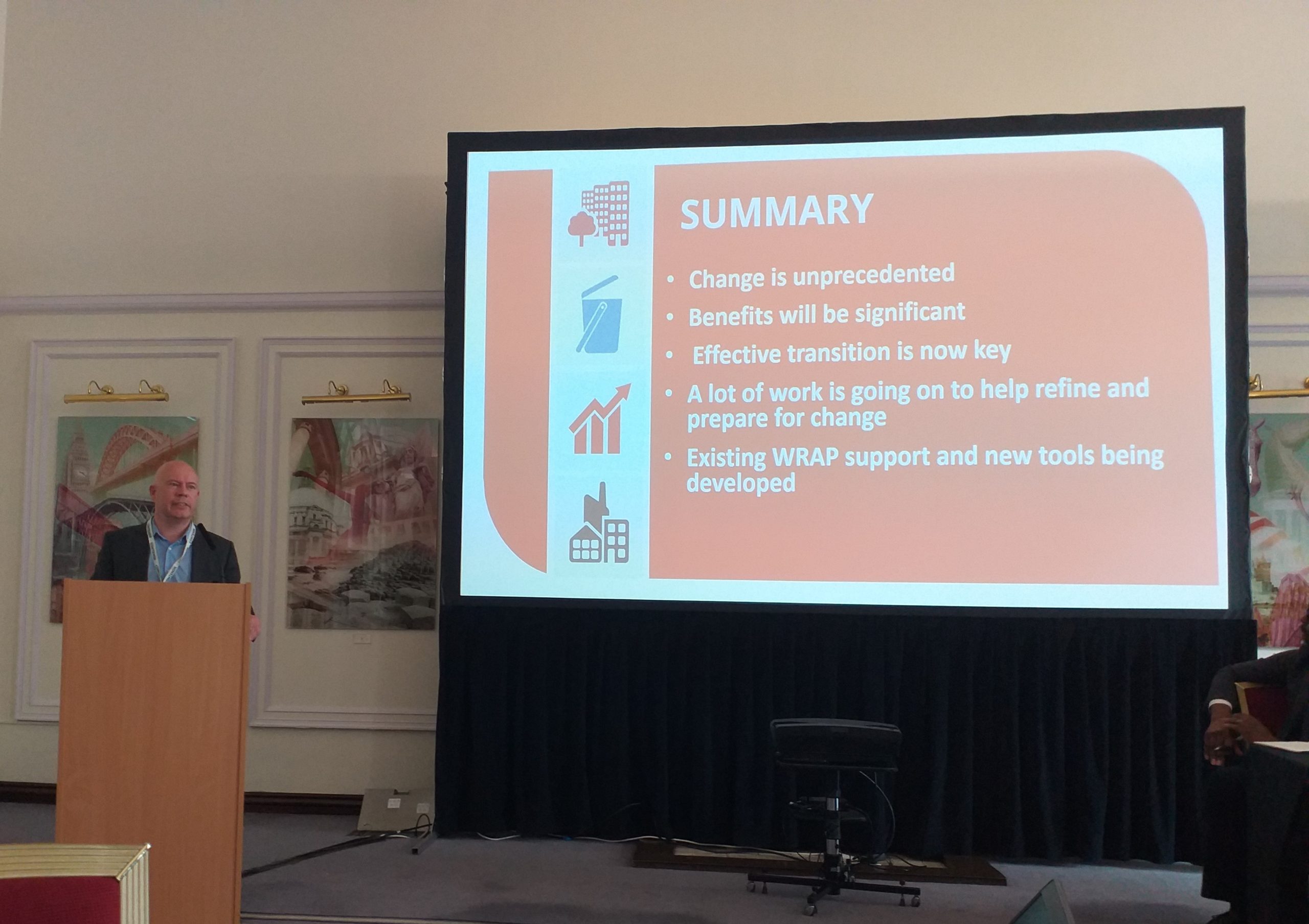
Mr Mills said: “There’ll be a lot of planning and preparing for change, which is happening behind the scenes at the moment. Then, there’ll be significant cross-sector transition in the next couple of years, all happening at the same time. As much we’d like everything to go perfectly well, something tells me they won’t and there’ll be a period of monitoring and refinement. This sort of change has never been done before – it’s almost unprecedented.”
Mr Mills suggested the business sector could “go a lot quicker” at improving recycling rates once the reforms were implemented because it was less likely than the local authorities to be tied into long-term contracts. “The recycling potential because of the waste composition can go much further,” he added.
However, Mr Mills expressed concern that many businesses were unaware they were soon to have increased obligations under EPR. “We’re trying to move 2.2 million businesses of all different shapes and sizes, and many don’t even know obligations are coming.”


Subscribe for free