


Guidance just issued by the European Commission offers more clarification as to how and when it is acceptable to deviate from the Waste Hierarchy when treating waste.
Under the terms of the Waste Framework Directive, Member States are required implement laws which will compel waste authorities and businesses to consider the five step waste hierarchy when handling waste.
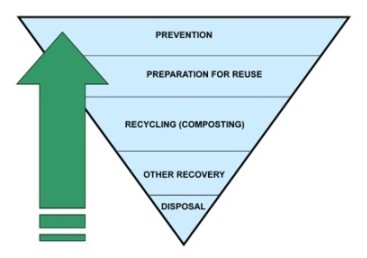
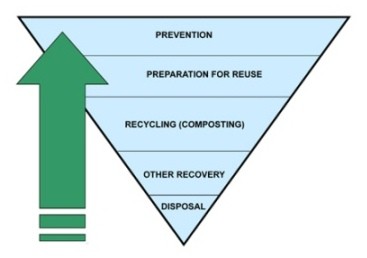
These five steps, in order of priority, are: prevention; preparation for reuse; recycling; other recovery (such as incineration); and disposal. The hierarchy is usually illustrated through using an inverted triangle with waste prevention at the top, with disposal the least favoured option at the bottom.
However, Article 4(2) of the rWFD does permit departure from the hierarchy for specific material streams where it can be justified that the overall environmental impact of the generation and management of waste is reduced.
Impact
The departure allows the freedom to encourage methods of waste treatment which have less impact on the environment, where following the waste hierarchy would increase the harm to the environment.
Guidance on the interpretation of key provisions of Directive 2008/98/EC on waste, published by the Commission on June 21 aims to help governments and organisations better interpret the terms of the Directive, in particular around Life Cycle Thinking (LCT) the decision making process used to determine when it is acceptable to deviate from the waste hierarchy.
The guidance document also sets out the European Commission’s stance on commingled recycling collections (see letsrecycle.com story).
The Commission claims that the fundamental objective of LCT is to be aware of the overall environmental impact of a product or service, and to ensure that these environmental impacts are not omitted when evaluating alternative methods of treatment to avoid shifting an environmental impact from one medium to another.
Policy
It is hoped that this will make decision-making around waste policy decisions transparent, based on sounder grounds and more efficient.
According to the Commission, LCT should involve a number of decision-support methods which provide science-based evidence to demonstrate when departing from the waste hierarchy is acceptable. These include the use of a Life Cycle Assessment (LCA), the most common method for determining the environmental impact of a service as well as Cost-Benefit Analysis (CBA), Life Cycle Costing (LCC), and Social LCA.
However, currently there is no legal requirement for these methods to be used when applying LCT to waste decisions.
The guidance also states that it is the responsibility of Members States to establish laws that make producers and holders of waste adhere to the waste hierarchy and to ensure that waste management plans are drawn up in accordance with the hierarchy.
End of Waste
On End of Waste, the guidance explains that these are conditions whereby substances of objects which meet the waste definition can, after undergoing a recovery operation, gain non-waste status and fall outside the scope of waste legislation. The Commission confirms that these will supersede standards already in place in Member States such as the Quality Protocols in the UK.
The guidance says: Once EoW criteria are set at Community level, these are binding for Member States…. Member States cannot apply different EoW provisions for the scope for which the criteria have been set at EU level with the exception of adopting more stringent protective measures.
Related Links
The guidance also confirms that End of Waste is achieved at the moment when a material of substances completes the recovery and recycling process or becomes a useful input for further processing.

Subscribe for free