




Mr Burdis, who previously served as head of waste management for Dorset county council, became director of the Partnership when it was established in early 2011.

He is also former chair of the National Association of Waste Disposal Officers, and was a key architect in designing the Shropshire Waste Partnership prior to his work with DWP.
His suspension comes as the county council carries out three separate reviews into the activities of DWP – the recommendations of which will be outlined in a report presented to the body’s joint committee next week.
These include an internal audit of vehicle hire by the South West Audit Partnership, and an efficiency review by local partnerships (jointly owned by the Treasury and Local Government Association). The chief executives of the seven Dorset partner councils have also commissioned consultants WYG to carry out a ‘wider-ranging’ review of DWP.
‘Recycle for Dorset’
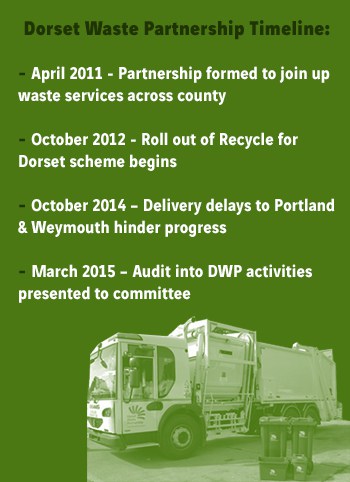
It follows problems with the roll out of the DWP’s new ‘Recycle for Dorset’ service, which has phased in alternating fortnightly dry recycling and refuse collections across the county.
The roll out began in October 2012 – but hit a snag in autumn 2014 following a delay in providing bins for some 50,000 residents in the Weymouth and Portland area.
And, DWP also predicted that it would require £2.3 million in excess of its budget to continue the roll out, which subsequently rose to an estimated £2.8 million due to unbudgeted costs – including a further £300,000 on hire vehicles.
According to a breakdown of the figures by the newly-installed DWP finance team, the costs making up the total overspend include:
- hire vehicles (£1.3m)
- operational staffing costs, including agency fees (£556,000)
- disposal costs for the increased total amount of household waste (£441,000)
- falling prices for recyclable materials, reducing income (£284,000)
- vehicle parts and maintenance (£115,000)
- two external reviews into the DWP (£52,000)
- other minor variances (£13,000)
In December, Mr Burdis told letsrecycle.com that the future of the scheme ‘looked positive’ – but conceded the delivery of new bins to the Weymouth area had not gone according to plan (see letsrecycle.com story).
He added that the financial adjustment was made due to external factors ‘which cannot be controlled’, including the speed at which a materials recycling facility (MRF) in Bournemouth could be brought into full operation.
‘Unacceptable’
But, commenting on the overspend last month, chairman of the DWP joint committee councillor Anthony Alford, called the increase ‘unacceptable’.
Cllr Ashford said: “The unexpected increase in the DWP overspend is unacceptable to partner councils, who joined together to deliver better services for local people at a reduced cost. Stringent measures are now in place to prevent future inaccuracy and restore partners’ confidence.
“Councillors will carefully consider the recommendations from the independent reviews to agree the necessary actions and future direction.
“Dorset councils remain committed to working together to provide the best possible waste services for the best possible value during these very challenging times.”
Temporary leadership of DWP will now be provided by Mike Harries, the county council’s director for Environment and Economy and chair of the DWP Management Board, and Steve Mackenzie, chief executive of Purbeck district council.
Consultants
WYG has also been appointed to provide temporary support to the DWP management team, oversee delivery of the improvement plan and restore confidence while ensuring services continue to be provided.
 It contrasts with DWP’s previous decision to commission consultancy firm Eunomia to carry out a brief legislative review of the service’s compliance with the waste regulations last year and to carry out some work back in the very early days of the Partnership.
In a testimonial for Eunomia, Mr Burdis had previously stated: “Eunomia has a strong reputation for their understanding of the Waste Regulations, they were instrumental in the writing of the Route Map and the obvious choice for us to look to.
“We have worked with Eunomia on a number of projects and the work they’ve done for Dorset Waste Partnership has always been excellent and I know that it is expert advice that I can rely on.”
Eunomia director James Fulford has been among those in the industry to defend Mr Burdis’ record at the helm of DWP, arguing his tenure has been hampered by external conflict.
At letsrecycle.com’s London Conference in Holborn last month, Mr Fulford said: “Steve Burdis has been given a torrid time in the press and by politicians. It’s unfortunate. He has been given a directive to carry out a service he has not had enough funding for.”

As the Unite union’s staff representative at West Dorset’s Poundbury Depot until my retirement late in 2014, I was never allowed to see the detailed costing’s of the refuse collection service provided for West Dorset residents prior to the creation of the DWP scheme, so was unable to consider our services financial value to our community as it stood at that time.
Suffice to say we had a top of the range of assorted refuse collection vehicles with good maintenance facilities and a fairly reasonable management structure to run the service.
The service we provided could easily have been adapted to improve our recycling targets without the recourse of joining the DWP . Further the joining of Weymouth with Dorchester to provide joint community services could have been extended to include a refuse collection service, and the pooling of refuse vehicles and staff would have enabled the conversion of some of these vehicles to dual stream recycle use at a not unreasonable cost.
We at Dorchester yard were told in no uncertain terms by the gentleman mentioned in the above article that we had to transfer across to the DWP scheme.
This all had an extremely detrimental effect on staff morale in the yard, which whilst we were under West Dorset Council management was quite high, this was proven by the very low turn over of front line staff prior to the inception of the DWP, indeed I worked for 2 years past retirement age because of the satisfaction I had with my job.
Studying the financial statements in the above article I wonder who will have to pick up the ”tab” for the DWP disaster, as I know the smaller district councils of Dorset are very short of money and further, who is going to pay for the fleet of 50 or so specialist vehicles which I was told are on order for the DWP ?.