

However, business bosses have said that with turnover increasing by £2.5 million and its workforce doubling to 116 staff, in the last year, it was time to expand. So, it has bought another site at the Roman Way Industrial Estate near Longridge, just outside Preston.
As well as housing the accounts department and its computer refurbishment business, Recycling.co.uk will move its cathode ray tube (CRT) recycling line, for recycling computer monitors and TVs, from Red Scar to the new facility in Longridge.
Here, the company will dismantle the equipment and separate the CRTs – the glass element in the TV which projects the picture onto the screen – from the plastic, metal and glass, all of which will be recycled by Recycling.co.uk. The CRTs are separated using a thermo-shock, hot wire separating technique, which will recover the clear class and metals contained within the tube.
Glass
This relocation of the CRT recycling line will free up space at Red Scar for a glass crushing line, which can process up to 45,000 tonnes of material each year. This will include material generated from the company's other recycling sectors, as well as bottles collected from pubs and clubs by community organisation EMPRISE Blackpool.
Using technology such as hammer mills and a mini-trommel, the glass is pulverized into tiny particles suitable for use in applications such as the manufacture of bricks, tiles and glazes.
Recycling.co.uk managing director Charles Jackson said: “This development gives us much needed breathing space. Taking the CRT recycling line over to the new premises means that we can now install a new, long-awaited glass crushing plant at our main recycling centre at Red Scar.”
The combined capacity for Recycling.co.uk's current recycling ventures is more than 100,000 tonnes. It accepts material from both businesses and councils including Lancashire Household Waste Recycling Centres.
WEEE and plastics
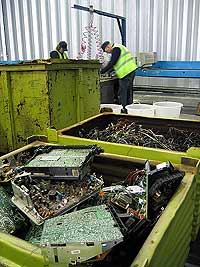
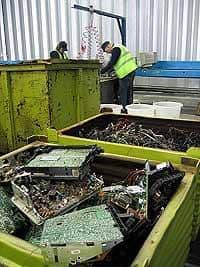
This includes WEEE, which is taken to the Red Scar Industrial Estate site where a shredding and sorting line – which can process up to four tonnes an hour – separates the metal and plastics in the items.
The metal is sorted into ferrous and non-ferrous before being reprocessed and sent to the UK and export markets.
Presently Recycling.co.uk cannot recycle the plastics taken from the electrical items but in the next few months, it plans to install its own extrusion lines to turn the WEEE-derived plastic into pellets. This will require additional investment on top of the £1 million expansion.
Mr Jackson explained: “We are also keen to close the loop on recycled plastics by developing our own manufacturing capability, so we will soon be installing two new polymer extrusion lines here on the Roman Way site and we expect them to become fully operational early in 2008.”

Subscribe for free