



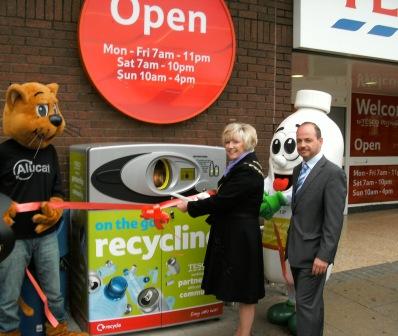
The store giant is installing the slimline banks outside 10 of its metro stores across Hertfordshire, Essex and Hampshire.
Speaking at the official opening of the first on-the-go bank at the Tesco Metro in Cheshunt this morning, Sion Stanfield, head of waste and recycling for Tesco, said: “Recycling, as we know, is a key issue for the community. Tesco as a responsible retailer is supporting the community to adopt greener habits.”
Environment
Mr Stanfield continued: “We want to make recycling easier, more convenient and fun and this is what recycling on-the-go machine is designed to do. We are also hoping to encourage more people such as pedestrians, shoppers and office workers to recycle waste whilst on the go.”
And, he added that he hoped the machine would help contribute to a better town environment through keeping streets cleaner.
Cllr Carol Crump-Eynon, mayor of the borough of Broxbourne which includes Cheshunt – where Tesco has its headquarters – said: “The machine demonstrates to me that Tesco has committed itself to being at the forefront of recycling in the UK.”
The mayor continued: “We have kerbside services to encourage people to recycle from the home. Outside the home the litter bin was the most attractive option. We now have Defra encouraging us to find ways to get people to recycle more away from the home and Tesco are certainly responding wholeheartedly to the cause and it is great they have chosen to do so in such an innovative way.”
The recycling unit, which has received planning permission, is supplied by Norwegian manufacturer Tomra which has now opened a UK base in Dunstable. Managing director Lars Andersen said that the unit is the first of its type “anywhere in the world. This is a bespoke design and we are excited to be developing this in the UK.”
Shredded
The unit takes plastic bottles and cans but not glass or paper. The plastic bottles are shredded and it is expected that it will handle about 900 bottles before needing to be emptied. The larger Tomra machines used by Tesco have a shredding and compaction rate of 14-1 but the smaller unit is less than this.
Cans are compacted into the right side of the machine which has two large containers, one for the plastic and one for the cans.
The machine has an electronic display to give instructions and if the wrong sort of material is placed in it, the user is asked to remove the item and it can be placed in a residual waste bin next to the machine.
Emptying will be by store staff and the material will be collected back-of-store with other supermarket material for recycling.
To try and reduce the impact of any vandalism, the machine will be switched off and the entrance hole shut when the store is closed.
Advice for the project also came from plastic bottle recycling organisation Recoup.

Subscribe for free