

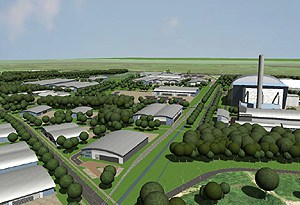

Proposals for the plant and the RRP were originally refused planning permission by the now-defunct Cheshire county council in 2006. However, Peel appealed the decision to the Secretary of State for communities and local government in January 2008 leading to a public inquiry (see letsrecycle.com story).
Inspectors then recommended that consent should be granted for the construction and operation of the plant and also that planning permission be given for the Resource Recovery Park.
Announcing the planning approval today, energy and climate change minister Lord Hunt said: “We need to increase our use of renewable energy and to find solutions to the UK's waste problem. This power plant will convert over half a million tonnes of waste each year into energy.
“The Inspector recommended the power plant be granted consent after a thorough public inquiry. I am satisfied that the mitigation measures to be put in place will protect the amenity of local villages,” he added.
Section 36 of the Electricity Act 1989 states that proposals to construct power stations with a capacity greater than 50 MW requires the Secretary of State for energy and climate change's consent.
Separate planning permission for the RRP was approved by Secretary of State for communities and local government, John Denham.
Plans
Under Peel Environmental's plans, a range of reprocessing activities are expected to take place on the site, including biodiesel and ethanol production, soil treatment and the re-use and recycling of plastic, wood, glass and waste electrical and electronic equipment.
Proposals for the RRP also includes an Integrated Waste Management Facility (IWMF) designed to complement the RDF plant. The IWMF is set to house: A mechanical biological treatment (MBT) plant; an in-vessel composting facility; a materials recycling facility; and, an industrial and commercial waste transfer station.
The majority of refuse derived fuel (RDF) for the energy from waste plant will be produced from municipal household waste pre-treated with the MBT. In addition to fuel from the MBT, some RDF may also be sourced from commercial and industrial waste, but only such wastes which have a similar character to the municipal household waste, such as cardboard and plastics.
The refuse-derived fuel facility is set to produce around 105MW of electricity which is generated by conversion of heat recovered from the combustion process. Then 95MW would be available to export to the local electricity network and the national grid.
No-one at Peel Environmental was available for comment.

Register for free to comment