

The Department had hoped to have 10 new residual waste management plants up and running by the end of this year to demonstrate the viability of new treatment processes.
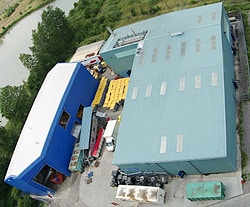
 Compact Power has found funding outside the Defra programme to build a gasification plant alongside this pilot facility in Bristol |
Shortlisted plants within the programme include proposals to demonstrate in-vessel composting techniques, gasification processes and anaerobic digestion.
Defra's head of new technologies, Dave Brooks, said yesterday that expectations are that four plants will now be up and running under the programme by the end of 2006, with “five or six demonstrating within the next two years”.
Speaking at the launch of Defra’s new technology education and training information pack in central London, Mr Brooks said: “We were ambitious to think we could get five by the end of 2005 and five more by the end of 2006. To get 10 new plants through planning, funding and licensing issues takes a lot of work.”
Plants
So far, only one plant – the Greenfinch and Shropshire Waste Partnership’s anaerobic digestion/biogas facility in Ludlow – has been opened officially.
Defra has now told letsrecycle.com that four plants have “completed the due diligence process and have signed contracts in place”. These are the Greenfinch plant, Novera Energy's gasification plant proposal for East London, the in-vessel composting plant run by Bioganix in Herefordshire and an anaerobic digestion plant run by Premier Waste Management in Durham.
However, Mr Brooks said yesterday that Novera’s gasification plant in East London is still going through due diligence, while the contract with Bioganix “should be signed in June”. He went on to reveal: “The ADAS in-vessel plant in Cambridgeshire should be running in June, and Premier Waste’s aerobic digestion in County Durham should be up by early 2007.”
”We were ambitious to think we could get five by the end of 2005 and five more by the end of 2006.“
– Dave Brooks, Defra
Waiting
Other projects still waiting to be approved by the Defra programme include an Energos gasification proposal for the Isle of Wight, a Yorwaste gasification proposal for Scarborough, Fairport's “complex materials recycling” and gasification proposal and Compact Power's pyrolysis and gasification proposal.
Compact Power's proposal, which has switched from the Devon site originally proposed to the company's site in Avonmouth, because planning permission was rejected. The project is subject to “particular due diligence” proceedings, Mr Brooks said yesterday. Compact Power has now secured funding for its Bristol plant from private sources, because Defra's approval process had been “dragging on and on” (see letsrecycle.com story).
There was no mention of the proposal from SITA UK and Golder Associates for an MBT/anaerobic digestion plant, which was announced as a possible project by minister Ben Bradshaw in Parliament on November 15.
Once all the plants are all up and running, it is expected that they will divert more than 240,000 tonnes of municipal waste from landfill.
One area of concern highlighted last July by Defra's advisory group, the New Technologies Advisory Committee, was that no autoclave technology was selected to demonstrate within the project. The technology involves treating mixed waste with steam to reduce its biodegradability.
Education pack
Yesterday also saw Defra's head of new technology pointing out that the Demonstrator projects are just one aspect of the New Technologies programme designed to promote the viability of new forms of waste treatment.
| Related links: |
The new information pack on education and training has been designed as a resource giving free information to academic institutions to include new technologies within waste management courses. The programme could also see a distance learning programme set up to widen its impact.
Mr Brooks said industry might cope with the lack of knowledge and training on new waste technologies by recruiting specialists from outside the waste sector.

Register for free to comment