
Waste legislation and definitions
Japans definition of waste is different to that of the EU Member States and many other countries in that it is discarded materials which cannot be sold to other people. Therefore the statistics for Japan look different in that waste paper, for example, is often collected by community groups for onward sale and therefore is missing from MSW statistics, although often added back in to provide a more comprehensive picture of recycling activities. Thus in 2008 for Japan as a whole, with a population of 127m, more than double that of the UK, there were 2.34m tonnes of recyclable wastes collected by municipalities, 4.51m reclaimed by intermediate treatment and 2.93m collected by citizens groups, totalling 9.78m tonnes or 20.3% of MSW.
The overarching legislation or basic framework act is the Basic Law Promoting the Creation of a Material-Cycle Society came in force in 2001. One subsidiary strand from that Act covers waste regulation, the Waste Management and Public Cleansing Act and the other is the Act on the Promotion of the Effective Utilisation of Resources, from where we get the 3Rs and other resource recovery measures.
Producer responsibility
Over time there has been an increasing emphasis on Extended Producer Responsibility (EPR) and on the 3Rs. EPR was first introduced for packaging in 1996 but only came into force in April 2000, the Containers and Packaging Recycling Law, and the system adopted most closely parallels the French eco-emballage scheme with the collection function retained by the municipalities but unlike France without payment for that collection. However, with both systems subsequent treatment and recycling rests with producers.
The system for WEEE, the Electric Home Appliance Recycling Law, put into force in 2001, is much simpler than the European model with only a limited range of the most common and heaviest domestic appliances affected: TVs, refrigeration equipment, air conditioners and washing machines. There is a recycling fee for each of these products paid by the consumer on the purchase of a new replacement product, the cost varying according to the costs of processing the equipment.
Recycling fee
The fee includes all the costs, including administrative overheads and all the transfer costs associated with getting the product from the final user through retailer and distribution centres to the dismantling facilities. Therefore the highest fee is around Y5,000 (37) for a large refrigerator and the smallest for washing machines. While this approach does not match up with the practice in most European countries, which have not opted for the visible fee system it does make sense in producer responsibility terms, if it is accepted that the purchase of goods by consumer effectively makes them the producer.
The Food Recycling Law, in force in 2001, does not affect households directly but requires the reuse of food waste by manufacturers, processors and retailers of food products. Likewise the Construction Materials Recycling Law places responsibility only on construction companies to sort and disassemble and recycle waste construction materials. The Law on Recycling of End-of-Life Vehicles affects those businesses that collect, disassemble and process used vehicles. Manufacturers are required to reuse air bags and shredder dust and destroy Freon from air conditioning units.
In addition, there is the Law on Promoting Green Purchasing, which came into force in 2001, under which the procurement of eco-friendly goods and services is led by the national government but whose principles should ultimately be trickled down through local government, business to all consumers
The Tokyo Super-Eco Town
Although described as the Tokyo Super-Eco Town the town is effectively several sites around Tokyo Bay, the project being one of 26 approved by central government in total. This eco-town received its approval in 2005. There are 9 facilities are currently located within the Eco-Town, including: PCB waste treatment, C&D waste recycling, used information equipment recycling, animal feed and biogas from food waste. I visited the following facilities: the Tokyo Waterfront Recycle Power company and the Tokyo PCB Waste Treatment Facility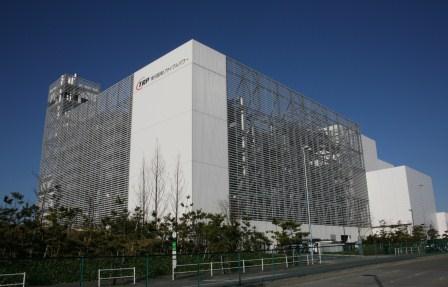
The plant manager for Tokyo Waterfront Recycle Power, Mr Ito, said that the company was established in 2002 as a subsidiary of the Tokyo Electric Power Company, the largest electrical power generating company in Japan, thereby expanding their operations into EfW. Becoming operational in 2006 the plant comprises two separate units: one to recover energy from industrial plastics waste and the other to incinerate healthcare waste but this also recovers the energy content, combining its smaller energy content to provide a single 23MW power train for the plant.
Plastics waste
The industrial waste delivered, while high in plastics wastes, is not exclusively plastics and will already have been through an intermediate processing facility so that it is delivered shredded to less than 150mm maximum dimension. In 2010 the company would have received a boost for its services, which cost more than landfill for larger industrial waste generators, when the City of Tokyo decided that smaller industrial generators of plastics waste would no longer be allowed to deposit waste at the landfill.
The processed waste delivered to the plant is deposited into a pit and then craned into hoppers to be fed into one of two fluidised bed gasification furnaces. There are two parallel lines of 275tpd. Any non-combustible materials fed into the fluidised bed combustors fall down through the sand bed and the mainly ferrous and aluminium fractions are recovered for recycling. The gases go through to a melting furnace operating at 1300oC and any further impurities are converted into a liquefied slag, which is quenched, crushed and taken away from the plant to be used as a constituent in paving blocks. The heat is utilised for electricity generation.
Healthcare waste
The healthcare waste facility also has two units, but in this case only rarely are both of the 50 tpd units working at the same time. The furnace used is a vertical furnace, unusual especially for healthcare waste, where the waste is retained for up to 4 hours. The healthcare waste comes mainly from hospitals and is delivered either in special plastic containers, which cannot be reopened once closed, and other potentially infectious wastes, such as nappies, which are placed in plastic bags but delivered to the plant in standard sized cardboard boxes. At the plant they are placed in a cooled storage area and from then on all the operations are controlled remotely, including loading onto the conveyor to be transferred to the furnace.
The Tokyo PCB waste treatment facility is not an incineration plant but a chemical treatment unit. It is operated by JESCO, the Japan Environmental Safety Corporation, and is one of 5 units placed strategically throughout Japan to treat PCBs, much of which has been stored in industrial warehouse units for more than 30 years. The site is located on reclaimed land on the inner side of the Central Breakwater in Tokyo Bay and services the four prefectures of Saitama, Chiba, Tokyo and Kanagawa.
The Japanese have great concerns about PCBs because of a contamination incident affecting rice oil in the 1970s and also the first attempt at high temperature incineration was not completely successful. Hence the long-term storage until a solution not incurring incineration could be developed. This required government intervention and finance and JESCO was formed in 2004 with the Tokyo plant starting operations in November 2005.
The plant has a capacity of only 2 tpd and uses two different methods for PCB decomposition, the treatment method depending on the type of equipment to decontaminate. Transformers, capacitors and ballasts (once used for florescent lighting) and small equipment is subjected to hydrothermal oxidation while the insulation oil of pole-mounted transformers is subjected to de-chlorination.
Removal of PCBs
The old transformers and other equipment have the PCBs removed, are thoroughly cleaned, cut in smaller fragments and completely decontaminated, all in a highly secure environment. The scrap is sold off but its value would only contribute a minimal fraction to defraying the costs of treatment. Larger companies pay the full costs of this treatment but smaller companies are subsidised. Tokyo, for example, budgets Y200m (1.5m) each year to support the disposal of PCBs held in the city by these smaller producers.
The transport to the plant is also undertaken to minimise any possibly of damage to the environment or public health. Special containers manufactured from stainless steel have to be used the transport the PCB waste to the treatment site and the transport operation is monitored through GPS. In addition there is an insurance requirement of Y300m (2.6m) for every load.
Although not likely to be the top of the tourists must see in Tokyo list the plant is open to the public between 10-16.00 weekdays and guided tours can be arranged by prior booking.
Thanks
My thanks go to my ISWA colleagues from Tokyo: Yasuo Fususawa and Takanobu Iwasaki for their kind hospitality during my stay in Tokyo.

Register for free to comment